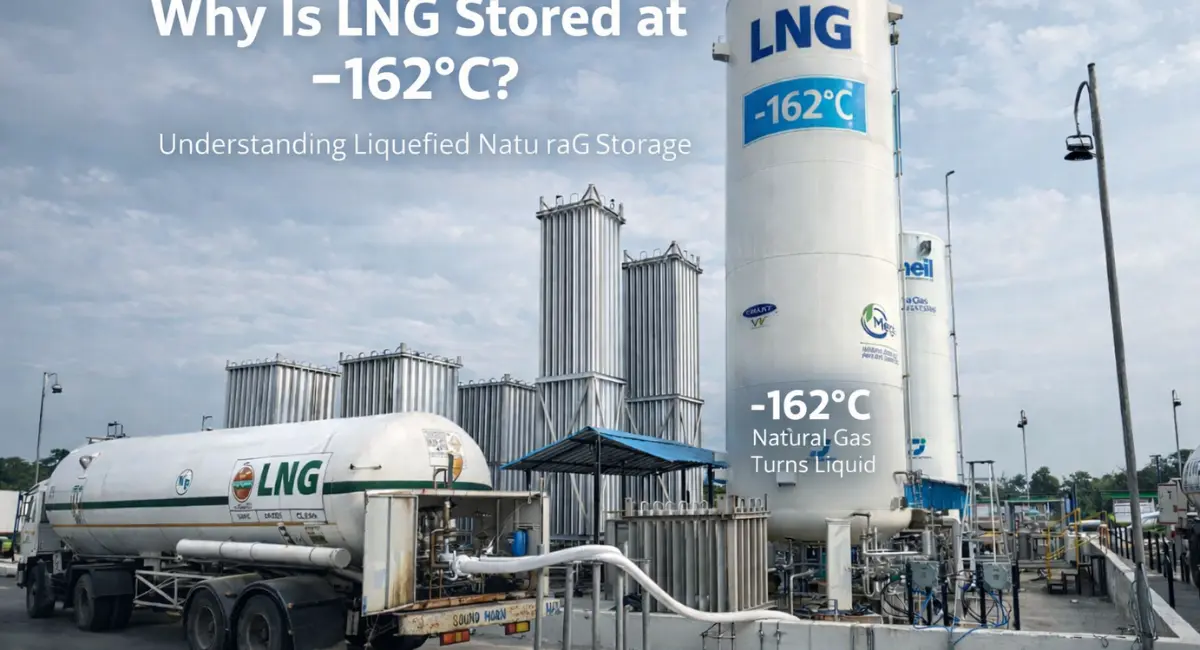
Why LNG is stored at –162°C
Why LNG is stored at –162°C is directly linked to the boiling point of methane, which allows natural gas to remain in liquid form at low pressure. Liquefied Natural Gas (LNG) is an important fuel used around the world for power generation, transportation, and industrial applications. One common question people often ask is, ‘Why is LNG always stored at –162°C?’
In this article, we explain why LNG is stored at –162°C, what happens at this temperature, and why it is important, in a simple and easy-to-understand way.
Why LNG Is Stored at –162°C
LNG stands for Liquefied Natural Gas. It is natural gas that has been cooled until it changes from a gas into a liquid.
Natural gas is mainly made up of methane, which becomes liquid only at extremely low temperatures.
The Boiling Point of Natural Gas
Why LNG is stored at –162°C is directly related to the boiling point of methane, the main component of natural gas.
- Methane boils at around –162°C at atmospheric pressure
- When natural gas is cooled to this temperature, it condenses into liquid form
This temperature is not chosen randomly—it is based on the physical properties of methane.
Why Liquefy Natural Gas?
LNG storage temperature plays a crucial role in LNG regasification, cryogenic storage tanks, and natural gas transportation systems.
1. Huge Volume Reduction
When natural gas is liquefied:
- Its volume reduces by about 600 times
- This makes storage and transportation much easier
See this example
- 600 cubic meters of gas → 1 cubic meter of LNG
2. Efficient Transportation
- LNG can be transported by ship or truck or stored in tanks
- Without liquefaction, long-distance transport would be very difficult
Why Exactly –162°C?
1. To Keep Natural Gas in Liquid State
- At temperatures higher than –162°C, LNG starts boiling
- Boiling creates boil-off gas (BOG)
- Storing LNG at –162°C minimises vaporisation.
2. Near Atmospheric Pressure Storage
- LNG is stored at low pressure
- Cooling to –162°C avoids the need for high-pressure tanks
- This improves safety and reduces tank cost
3. Stable and Safe Storage
- At this temperature, LNG remains stable
- Controlled boil-off gas can be safely managed
- Reduces risk of overpressure
What Happens If Temperature Increases?
If LNG warms up:
- It starts evaporating
- Pressure inside the tank increases
- Boil-off gas is generated
This is why LNG tanks are:
- Double-walled
- Vacuum insulated
- Designed to handle BOG safely
How LNG Is Stored at –162°C
LNG storage tanks use:
- Thick insulation
- Special cryogenic steel
- Temperature monitoring systems
- Pressure relief and vent systems
These features maintain LNG at the required low temperature.
Is –162°C Dangerous?
Yes, extreme cold can cause:
- Material brittleness
- Frostbite on contact
That’s why:
- Special materials are used
- Strict safety procedures are followed
- Trained personnel handle LNG
Benefits of Storing LNG at –162°C
- Compact storage
- Lower transport cost
- Safer low-pressure storage
- Enables global LNG trade
Conclusion
LNG is stored at –162°C because this is the temperature at which natural gas becomes a liquid. Liquefaction reduces volume drastically, making storage and transportation economical and safe. Maintaining LNG at this temperature ensures stable operation and efficient use of natural gas across the world. LNG storage practices are followed worldwide based on international cryogenic engineering standards and operational safety guidelines.LNG storage standards are defined by international bodies such as the International Energy Agency (IEA) and ISO cryogenic safety guidelines.
Why is LNG stored at –162°C?
LNG is stored at –162°C because this is the boiling point of methane at atmospheric pressure. At this temperature, natural gas turns into liquid, making storage and transportation easier and safer.This explains why lng is stored at –162°C for safe and efficient storage and transportation worldwide.
What is the boiling point of LNG?
The boiling point of LNG (mainly methane) is approximately –162°C at atmospheric pressure.
What is the freezing or melting point of LNG?
The freezing or melting point of LNG is around –182°C. LNG is normally stored above this temperature so it remains in liquid form.
What happens if LNG temperature increases?
If LNG warms above –162°C, it starts to evaporate and produces boil-off gas (BOG). This increases pressure inside the tank, which is why LNG storage systems are designed to manage BOG safely.
Is storing LNG at –162°C safe?
Yes. LNG storage at –162°C is safe when proper cryogenic materials, insulation, and safety systems are used. LNG is stored at low pressure, which improves safety.
Why is LNG stored at low pressure?
LNG is stored at low pressure because cooling natural gas to –162°C keeps it in liquid form without the need for high-pressure tanks.
Why is LNG not stored as a solid?
Storing LNG as a solid would require temperatures below –182°C, which is unnecessary and inefficient. Keeping LNG as a liquid is more practical for storage and transport.
LNG stands for Liquefied Natural Gas. It is natural gas that has been cooled, a process explained in detail in our guide on how natural gas is processed and liquefied
One thought on “Why LNG is stored at –162°C”