Top 10 African Nations with Huge Natural Gas Reserves You Probably Didn’t Know About
Top 10 African Countries with Natural Gas Reserves. Yeah… Africa Have Gas — A Lot More Than the World Realises. When people talk about natural gas, the spotlight usually falls on the Middle East, Russia, or the United States.
Africa rarely makes the headline.
But here’s the truth most people don’t know.Africa is sitting on one of the world’s largest and fastest-growing natural gas bases, which is quietly reshaping global energy, LNG trade, and even climate discussions.
As of the early 2020s, nearly half of Africa’s 55 countries have proven natural gas reserves. total of more than 800 trillion cubic feet (Tcf). And according to long-term projections, gas production in Africa is expected to grow by nearly 80% by 2035, driven by LNG demand, power generation needs, and economic growth.
So where exactly is all this gas—and what does it mean for Africa and the climate… ?
Let’s break it down.
Africa’s Natural Gas Story in One Line
In a single word: huge reserves, uneven development, rising global importance.
Natural gas has become one of Africa’s most valuable energy assets. It supports:
Power generation
Industrial growth
LNG exports
Government revenue
Energy access for millions
Yet, the reserves are highly concentrated in a few countries. According to global reserve data, Africa hosts several countries among the world’s largest holders of proven natural gas reserves.
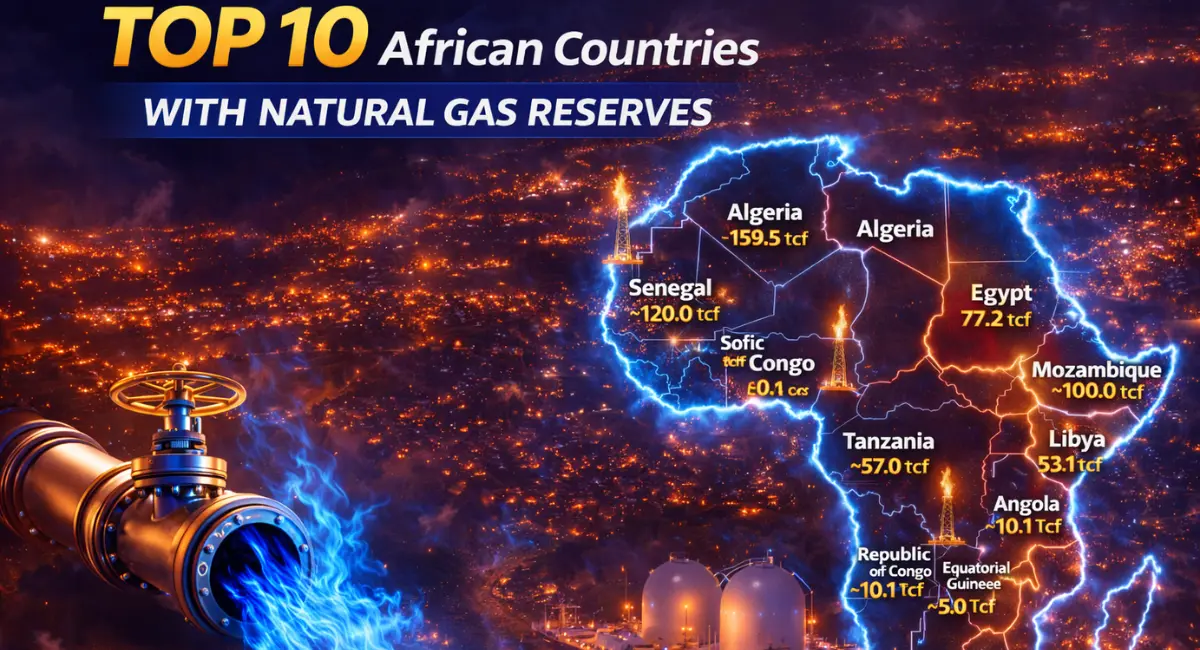
Top 10 African Countries with Natural Gas Reserves (By Volume)
1. Nigeria — 206.5 Trillion Cubic Feet
Yes, Nigeria is Africa’s gas giant. It holds the largest natural gas reserves on the continent and ranks among the top gas nations globally.
Gas and oil together contribute:
~20% of GDP
~95% of foreign exchange earnings
Nigeria’s biggest gas player, Nigeria LNG (NLNG), has positioned the country as a key LNG exporter, though gas flaring and infrastructure gaps remain major challenges.
2. Algeria — 159.1 Trillion Cubic Feet
Algeria is Africa’s most reliable gas supplier to Europe. With pipelines and LNG terminals already in place, gas contributes around one-third of its GDP.
The state-owned company Sonatrach dominates production and is one of Africa’s largest energy companies.
3. Senegal — ~120 Trillion Cubic Feet
Senegal is one of Africa’s newest gas success stories. Offshore discoveries like Grand Tortue Ahmeyim (GTA) and Yakaar–Teranga have transformed the country into a future LNG exporter.
The GTA project alone is expected to produce:
2.5 million tonnes of LNG per year
Large volumes of domestic gas for Senegal and Mauritania
4. Mozambique — ~100 Trillion Cubic Feet
Mozambique’s offshore Rovuma Basin discoveries changed Africa’s gas map. With enough gas to meet over 1,500 years of domestic demand, the country is positioned as a long-term LNG powerhouse—once security and investment challenges are resolved.
5. Egypt — 77.2 Trillion Cubic Feet
Egypt is both a major gas producer and Africa’s largest gas consumer. Discoveries like Zohr turned the country into a regional gas hub, supporting LNG exports and pipeline trade across the Eastern Mediterranean.
6. Tanzania — ~57 Trillion Cubic Feet
Tanzania’s gas lies mainly offshore in deep water. While development has been slow, the country holds significant long-term LNG potential.
7. Libya — 53.1 Trillion Cubic Feet
Libya exports gas to Europe via pipelines and LNG, but political instability continues to limit full-scale development.
8. Angola — 13.5 Trillion Cubic Feet
Angola is oil-dominated, and much of its gas is still flared or reinjected. Even so, gas remains critical for power generation and LNG exports.
9. Republic of the Congo — 10.1 Trillion Cubic Feet
Often overlooked, Congo is strengthening gas-to-power projects and regional supply with support from international operators.
10. Equatorial Guinea — 5 Trillion Cubic Feet
Small country, big LNG role. Equatorial Guinea exports gas mainly as LNG and punches above its weight in regional gas trade.
How Is Natural Gas Actually Used in Africa…?
Most people associate gas with cooking—but in Africa, its role is much broader.
Natural gas is used for…
Electricity generation
Industrial heat and processing
LNG exports
Petrochemicals, plastics, and fertilizers
Domestic cooking and heating
In 2023, natural gas accounted for about 17.6% of Africa’s total energy supply, with total gas supply reaching nearly 6 million terajoules (TJ)—more than triple the level in 2000.
Production, Imports, and Exports — The Reality Check
Africa produces more gas than it consumes.
Domestic gas production (2023): ~8.8 million TJ
Net gas exports: ~32% of total production
Global share: ~6% of world gas production
Top producers include:
Algeria
Egypt
Nigeria
LNG has become critical, allowing African gas to reach Europe and Asia—especially after the 2022 global energy crisis.
Africa’s natural gas reserves are developed and operated by major national and international oil and gas companies that play a key role in upstream production, LNG exports, and domestic gas supply.
Climate Impact: Is Natural Gas a Problem or a Bridge ?
Natural gas burns cleaner than coal and oil, emitting less CO₂. That’s why it’s often called a transition fuel.
But it’s not emission-free.
Key climate concerns:
Methane leaks from pipelines and facilities
Gas flaring and venting
Emissions from LNG processing and transport
To meet global climate targets, Africa’s gas growth must be paired with…
Methane control
Better infrastructure
Reduced flaring
Cleaner power integration
Conclusion: Africa’s Gas Is Not the Future — It’s a Choice
Africa doesn’t just have gas.
It has options.
Natural gas can:
Power industries
Lift millions out of energy poverty
Support renewables
Strengthen global energy security
But reserves alone don’t create value. Execution does. How Africa develops its gas—safely, efficiently, and responsibly—will define its energy future for decades.
Also read: How liquid natural gas is processed, transported through pipelines, and supplied to power plants and industries.