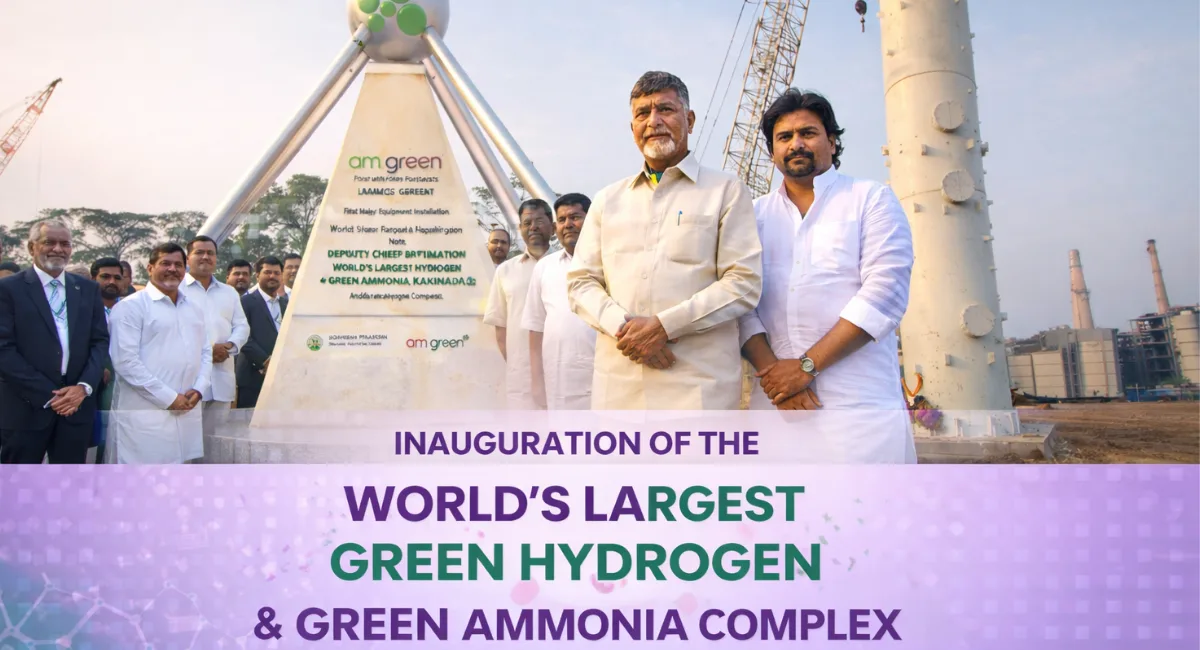
Green Hydrogen Valley of India: Germany Turns to Kakinada for Green Ammonia
Andhra Pradesh Chief Minister N. Chandrababu Naidu has declared Kakinada as the “Green Hydrogen Valley of India”, marking a major milestone in India’s clean energy transition. The announcement came after he laid the foundation stone for AM Green’s ₹15,600-crore Green Hydrogen and Green Ammonia Production Complex, touted to be the world’s largest of its kind.
The Chief Minister was accompanied by Deputy Chief Minister Pawan Kalyan during the bhumi puja ceremony held at the 495-acre project site in Kakinada, previously owned by Nagarjuna Fertilisers.
World’s Largest Green Ammonia Project
Developed by AM Green, part of the Greenko Group, the project aims to produce 1.5 million tonnes of green ammonia annually. The first phase, with a capacity of 0.5 million tonnes, is expected to commence operations by mid-2027.
Calling the project transformational, Mr Naidu said it would place Andhra Pradesh at the forefront of the global green fuels market while supporting India’s decarbonisation goals. Earlier, India announced several large-scale initiatives under its clean energy mission to reduce carbon emissions and promote green fuel exports, with Bharat Petroleum Corporation Limited actively exploring green hydrogen and sustainable refining pathways.
Why Kakinada Matters in India’s Green Energy Strategy
The development of Kakinada as the Green Hydrogen Valley of India is a strategic move aligned with India’s long-term clean energy roadmap. Located on the East Coast, Kakinada offers proximity to ports, renewable power sources, and global shipping routes, making it ideal for large-scale green hydrogen and green ammonia production.
The project supports India’s target of achieving 500 GW of renewable energy capacity and strengthens the country’s ambition to become a global exporter of green fuels. With strong policy backing, export agreements, and world-scale infrastructure, Kakinada is expected to attract further investments in clean energy, logistics, and advanced manufacturing.
As global demand for green hydrogen and ammonia continues to rise—especially in Europe—the Kakinada project positions India as a reliable and competitive supplier in the international market. This transition marks a shift from fossil fuel dependence to sustainable industrial growth, reinforcing India’s leadership in the global energy transition.
Europe and Germany to Be Key Export Markets
According to the Chief Minister, green ammonia produced in Kakinada will be primarily exported to Europe, with Germany emerging as the largest buyer. The project aligns with India’s National Green Hydrogen Mission and strengthens international energy partnerships.
Earlier this month, India and Germany welcomed the signing of one of the largest green ammonia offtake agreements between AM Green and Uniper Global Commodities, reinforcing Kakinada’s global relevance in the clean energy supply chain.
Investment in Electrolysers and Renewable Power
Mr Naidu announced that AM Green would invest an additional ₹2,000 crore to deploy 2 GW of alkaline electrolysers at the Kakinada complex. The hydrogen required for ammonia production will be generated entirely using renewable energy sources.
He noted that Andhra Pradesh’s nearly 1,000-km coastline, combined with strong solar and wind potential, gives the state a natural advantage in producing low-cost green energy.
Economic, Environmental and Agricultural Benefits
Highlighting the wider impact, the Chief Minister said green ammonia would support soil health and fertiliser security, especially as Andhra Pradesh ranks high in soil nitrogen and salinity levels. The project will also contribute significantly to carbon emission reduction and industrial decarbonisation.
Once exports begin, Kakinada is expected to gain international recognition as a major clean energy hub.
With LNG import terminals located across India’s western and eastern coasts, the country has significantly strengthened its natural gas infrastructure to support cleaner energy consumption and reduce dependence on conventional fuels
Power Reforms and Technology Push
Mr Naidu stated that Andhra Pradesh’s power sector reforms could reduce electricity procurement costs from ₹4.80 per unit to nearly ₹1.19 over the next three years by maximising renewable energy usage and minimising transmission losses.
He also announced:
Launch of the State’s first drone ambulance service this year
Introduction of quantum computing facilities in Amaravati within nine months
Expansion of drone-based mobility and advanced technology services
A National Green Energy Hub in the Making
Reiterating the State government’s commitment, Mr Naidu assured full support to AM Green founder Anil Chalamalasetty and Group President Mahesh Kolli to ensure timely execution of the project under the AP Integrated Clean Energy Policy-2024.
With large-scale investments, export-orientated production, and strong policy backing, Kakinada is poised to become a global centre for green hydrogen and green ammonia, driving India’s next phase of clean industrial growth.
Globally, energy majors such as Saudi Aramco are accelerating investments in low-carbon fuels, hydrogen and ammonia as part of the worldwide transition to clean energy.