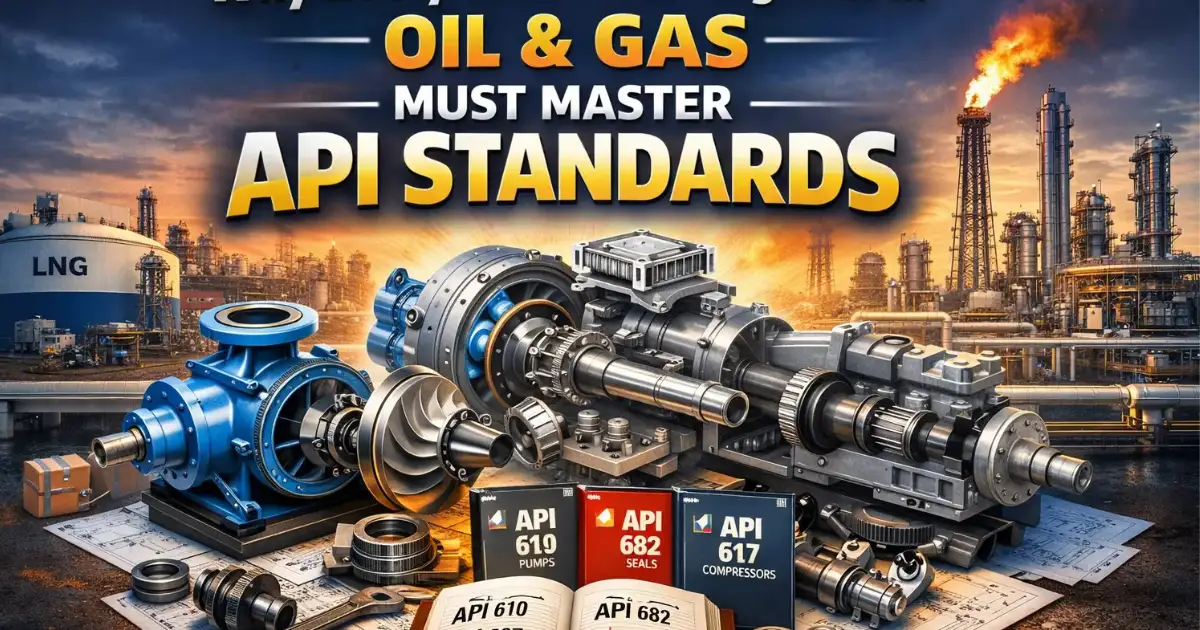
API Standards for Oil and Gas Engineers: Why You Must Master Them
API standards for oil and gas engineers define the minimum technical requirements for safe, reliable, and efficient operation of equipment, piping, and systems in oil and gas plants.
Introduction
API standards for oil and gas engineers define the minimum technical requirements for safe, reliable, and efficient operation of equipment, piping, and systems in oil and gas plants. For oil and gas engineers, API standards define the minimum technical requirements for safe, reliable, and globally accepted plant operation. In the oil & gas industry, rotating equipment is not just machinery — it is the heartbeat of production.
From LNG terminals and refineries to gas processing plants, equipment such as pumps, compressors, and turbines operates continuously under extreme conditions:
- High pressures
- Elevated temperatures
- Corrosive and hazardous fluids

A single failure can trigger plant shutdowns, safety incidents, and massive financial losses.
This is exactly why API standards exist.
They are not optional documents or “reference material for later”. They are the engineering rulebook of oil & gas.
What Are API Standards?
API standards are published by the American Petroleum Institute and define how rotating equipment must be designed, manufactured, tested, installed, operated, and maintained.
In real-world oil & gas projects:
OEMs design equipment to API
EPCs specify equipment as per API
Operators audit failures against API
Maintenance teams repair equipment following API
If you don’t understand API standards, you’re technically blind in this industry.
Why API Standards Matter So Much
API standards help engineers to:
- Ensure equipment reliability & availability
- Reduce unplanned shutdowns
- Improve process and personnel safety
- Standardise best practices globally
- Protect people, assets, and the environment
In short:
Most rotating equipment failures happen when API principles are ignored. API standards play a critical role in ensuring safe and reliable operations at LNG terminals in India, where rotating equipment and piping systems operate under extreme cryogenic conditions.
Core API Standards Every Rotating Equipment Engineer Must Know
🟦 API Standards for Pumps
API 610 – Centrifugal Pumps
The most important pump standard in oil & gas.
Used extensively in:
- Refineries
- Petrochemical plants
- LNG & gas processing facilities
Covers:
- Hydraulic design
- Materials of construction
- Bearings & lubrication
- Mechanical seals
- Testing & reliability criteria
If you work with process pumps, API 610 is non-negotiable.
API 674 / API 675 / API 676 – Positive Displacement Pumps
Essential for:
- Chemical injection systems
- Metering & dosing
- High-pressure services
Includes:
- API 674 – Reciprocating pumps
- API 675 – Controlled-volume pumps
- API 676 – Rotary PD pumps
API 682 – Mechanical Seals
One of the most critical standards for pump reliability.
Defines:
- Seal categories & arrangements
- Flush plans
- Leakage control philosophy
Wrong seal selection = leaks, fires, frequent shutdowns.
API RP 691 – Risk-Based Machinery Management
Introduces risk-based maintenance, replacing blind time-based schedules.
Helps identify:
- Critical equipment
- Failure consequences
- Maintenance priorities
To know more about units used in oil and gas and natural gas measurement, refer to our detailed guide.
🟦 API Standards for Compressors
API 617 – Axial & Centrifugal Compressors
Widely used in:
- LNG plants
- Gas processing units
- Refining operations
Covers:
- Aerodynamic design
- Performance testing
- Reliability requirements
API 618 – Reciprocating Compressors
Vital for high-pressure gas services.
Focus areas:
- Pulsation control
- Vibration limits
- Valve & cylinder reliability
Long compressor life depends heavily on API 618 compliance.
API 619 – Rotary-Type Positive Displacement Compressors
Used for screw and rotary compressors in gas applications.
API 672 – Packaged Integrally Geared Compressors
Common in:
- Refineries
- Air separation units
- Process industries
API 692 – Dry Gas Sealing Systems
A mission-critical standard for modern compressors.
Ensures:
- Seal integrity
- Reduced gas leakage
- Emissions control
🟦 Installation, Reliability & Maintenance (Where Failures Begin)
API RP 686 – Machinery Installation & Installation Design
One of the most underrated yet powerful standards.
Reality check:
❌ Poor installation = guaranteed failure, no matter how good the equipment is.
Covers:
- Foundations & grouting
- Shaft alignment
- Piping strain control
To know more about CNG vs LNG vs PNG. Check our detailed comparison.
API RP 687 – Repair of Rotating Equipment
Ensures repairs:
- Restore original design intent
- Or improve reliability beyond OEM condition
Essential for overhaul engineers.
API 684 – Rotor Dynamics & Balancing
Critical for high-speed rotating equipment:
- Vibration analysis
- Critical speed evaluation
- Dynamic balancing
API 688 – Pulsation & Vibration Control
Important for:
- Reciprocating compressors
- PD pumps
- Complex piping systems
API RP 697 – Pump Repair
Defines best practices to ensure repaired pumps don’t become repeat failure cases.
For mechanical engineers in oil & gas, LNG, and LCNG, API standards are not optional skills — they are career survival tools.
Mastering API standards means:
- Fewer failures
- Higher technical credibility
- Better global job opportunities
- Stronger safety culture
Equipment doesn’t fail suddenly — it fails when standards are ignored. API knowledge helps you see failures before they happen.
API Standards for Piping, Pipes, Valves & Fittings (Often Overlooked)
In LNG and LCNG plants, piping systems are as critical as pumps and compressors.
A failure in piping can lead to gas leaks, fire hazards, pressure loss, and shutdowns.
This is where API + ASME piping standards come into play.
API 5L – Line Pipe
One of the most widely used standards for oil & gas pipelines.
Covers:
- Carbon steel line pipes
- Seamless & welded pipes
- Pressure-containing capability
- Material grades & testing
Used in:
- Gas transmission lines
- Process piping headers
- Utility gas pipelines
API 570 – Piping Inspection Code
A must-know standard for operations & maintenance engineers.
Defines:
- Inspection intervals
- Corrosion monitoring
- Remaining life assessment
- Fitness-for-service decisions
Critical for ageing LNG/LCNG plants.
API 6D – Pipeline Valves
Applies to:
- Ball valves
- Gate valves
- Plug valves
- Check valves
Used in:
- Isolation of gas lines
- Emergency shutdown systems
- High-pressure gas services
Ensures:
- Leak-tight shutoff
- Fire-safe design
- Operational reliability
🟦 ASME Standards (Used Alongside API)
While API defines industry requirements, piping design is often governed by ASME codes.
ASME B31.3 – Process Piping
This is the core piping code for LNG, LCNG, refineries, and gas processing plants.
Covers:
- Pipe thickness calculation
- Allowable stresses
- Material selection
- Design pressure & temperature
- Fabrication & testing
Why SS 304L Is Used in LNG/LCNG Plants
SS 304L (low carbon stainless steel) is commonly used for:
- Gas lines
- Instrument tubing
- Low-temperature & corrosive services
Advantages:
- Excellent corrosion resistance
- Better weldability (low carbon)
- Reduced risk of carbide precipitation
- Suitable for cryogenic and gas services
Material selection is verified against ASME B31.3 + API inspection standards.
Key Takeaway for Mechanical Engineers
API standards do not stop at pumps and compressors.
A complete oil & gas mechanical engineer must understand:
- API for rotating equipment
- API for piping & valves
- ASME for piping design
- API for inspection & integrity
Many real-life failures happen not because of bad equipment,but due to wrong material selection, poor piping design, or ignored inspection codes
To know more about how LNG invoicing works, including billing and measurement, refer to this article.