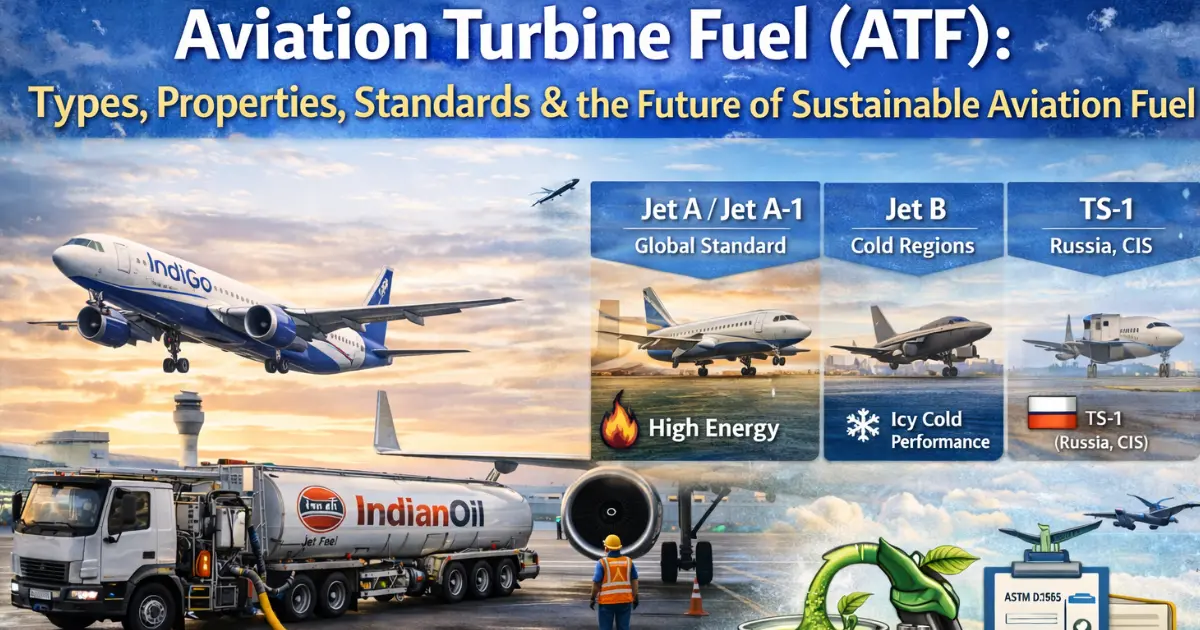
Aviation Turbine Fuel (ATF): Types, Properties, Standards & the Future of Sustainable Aviation Fuel
Introduction
Aviation Turbine Fuel (ATF), commonly known as jet fuel, is the lifeblood of modern aviation. From commercial airliners cruising at 35,000 feet to military aircraft operating in extreme environments, ATF is specially engineered to deliver high energy, safety, and reliability under demanding conditions.
ATF is a kerosene-based hydrocarbon blend—not a single compound—designed for energy, safety, and extreme cold performance. Unlike petrol or diesel, aviation fuel has no single molecular formula.
Jet fuels like Jet A-1 are kerosene-based hydrocarbon blends (typically C₁₀H₂₀ to C₁₂H₂₄) engineered for high energy density, low freezing point, and clean combustion at cruising altitudes.
Aviation turbine fuels are defined by performance specifications rather than a fixed chemical composition, ensuring consistent behaviour across varying climates, altitudes, and engine designs.
What is Aviation Turbine Fuel (ATF)?
Aviation turbine fuel is a petroleum-based fuel designed for aircraft powered by gas-turbine engines, including jet engines, turboprops, and helicopters. According to guidance from the International Air Transport Association (IATA), strict fuel handling and quality control are essential for safe aircraft operations.
Key characteristics:
- Colorless to straw-colored
- High energy content
- Low freezing point
- High flash point for safer handling
- Clean-burning and thermally stable
ATF primarily consists of a mixture of hydrocarbons, mostly in the kerosene range, optimised for combustion efficiency and operational safety.
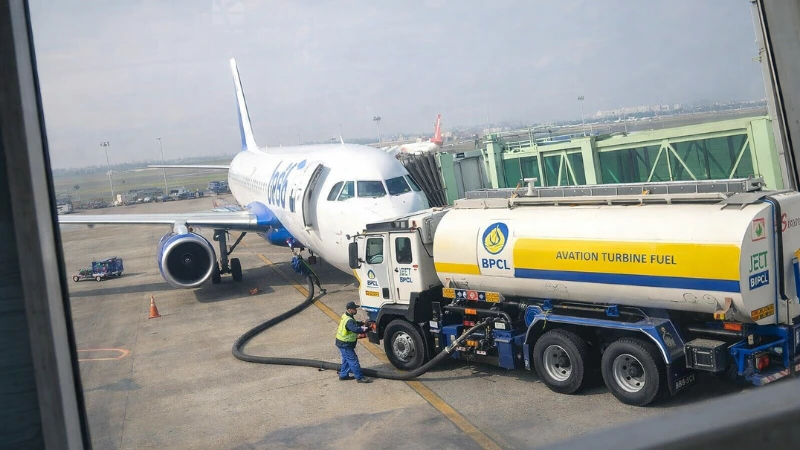
Why Kerosene is Used in Jet Engines
Early turbine engines experimented with multiple fuels, but kerosene-type fuels proved ideal due to:
- Lower volatility than gasoline
- Reduced fire risk during ground handling
- Better safety in crash scenarios
- Higher volumetric energy density
- Stable combustion at high altitudes
Today, kerosene-based fuels dominate global aviation. Read the classification below
Main Types of Aviation Turbine Fuel
1. Jet A & Jet A-1 (Most Common)
Jet A
- Used mainly in the United States
- Freezing point: –40°C
- Flash point: ≥38°C
- ASTM D1655 specification
Jet A-1 (Global Standard)
- Used worldwide
- Lower freezing point: –47°C
- Mandatory anti-static additive
- Meets:
ASTM D1655
DEF STAN 91-91
NATO Code F-35
Jet A-1 is preferred for long-haul international flights due to superior cold-weather performance.
To learn more about natural gas as a rapidly emerging energy source, explore our detailed guide on natural gas.
2. Jet B (Wide-Cut Fuel)
- Blend of kerosene and gasoline
- Very low freezing point: –60°C
- Low flash point (more flammable)
- Used only in extremely cold regions like northern Canada and Alaska
3. Russian & CIS Jet Fuels (TS-1)
- Governed by GOST standards
- Main grade: TS-1
- Lower flash point (~28°C)
- Freezing point below –50°C
- Comparable to Jet A-1 in performance
- Widely used across Russia and CIS countries
Typical Physical Properties of Jet Fuel
| Property | Jet A-1 |
|---|---|
| Flash Point | ≥38°C |
| Freezing Point | –47°C |
| Auto-Ignition Temp | ~210°C |
| Density at 15°C | ~0.804 kg/L |
| Specific Energy | ~43 MJ/kg |
These properties ensure reliable operation at high altitude and extreme temperatures.
If you want a complete list of LNG terminals in India, including operational and upcoming projects, see our dedicated article
Additives Used in Aviation Turbine Fuel
Jet fuel contains carefully controlled additives to enhance safety and performance:
- Antioxidants – prevent gum formation
- Antistatic agents – reduce static electricity
- Corrosion inhibitors – protect fuel systems
- Fuel System Icing Inhibitors (FSII) – prevent ice blockage
- Biocides – control microbial growth
- Metal deactivators – improve thermal stability
Each additive is strictly regulated under ASTM and DEF STAN standards.
Water Contamination in Jet Fuel
Water presence in ATF is a serious concern:
- At high altitude, dissolved water can freeze
- Ice crystals may block fuel lines
- This was a contributing factor in British Airways Flight 38
Prevention methods:
- Fuel heaters
- Water-separating filters
- ASTM D3948 water separation testing
- Regular quality checks (max. 30 ppm free water)
Military Jet Fuels (JP Series)
Military aviation uses specialised fuels for extreme missions:
| Fuel Type | Application |
|---|---|
| JP-4 | Older wide-cut military jet fuel |
| JP-5 | Aircraft carrier operations (high flash point) |
| JP-8 | NATO standard, multi-use military fuel |
| JP-7 | High-speed aircraft like SR-71 Blackbird (Mach 3+) |
| JP-10 | Cruise missiles and high-energy propulsion systems |
JP-8 is widely used as a universal fuel for both aircraft and ground vehicles.
How Aviation Turbine Fuel is Produced
Crude oil distillation
Extraction of kerosene fraction
Hydrotreating to remove sulfur and impurities
Blending to meet performance specs
Additive injection
Quality testing and certification
Also, to know the comparison of LNG, CNG, and PNG to understand their differences and applications.
Sustainable Aviation Fuel (SAF)
What is SAF?
Sustainable Aviation Fuel is a low-carbon alternative to conventional jet fuel that can reduce lifecycle CO₂ emissions by up to 80%.
Common SAF Types:
- HEFA-SPK – from waste oils & fats
- FT-SPK – Fischer-Tropsch synthesis
- ATJ-SPK – Alcohol-to-Jet
SAF is fully compatible with existing aircraft when blended with conventional ATF.
Why SAF is Needed
- Aviation contributes ~2.5% of global CO₂ emissions
- Air traffic demand is growing ~4.3% annually
- Limited electrification options for long-haul flights
- Pressure from global climate commitments (ICAO, Paris Agreement)
Challenges in SAF Adoption
- High production costs (50–200% more than ATF)
- Limited feedstock availability
- Complex supply chains
- Insufficient global production capacity
- Regulatory and certification hurdles
The Future of Aviation Fuel
The future lies in:
- Scaling SAF production
- Policy incentives and subsidies
- Technological innovation
- Global harmonization of standards
- Gradual increase in SAF blending ratios
Aviation turbine fuel will remain essential, but sustainable fuels will define the next era of aviation.
Conclusion
Aviation turbine fuel is a highly specialised energy source designed for safety, efficiency, and reliability in the harshest operating conditions. While Jet A-1 remains the global standard today, the aviation industry is actively transitioning toward sustainable aviation fuel to reduce emissions and secure a greener future.
Also read our detailed guide on the LNG unloading process at import terminals
One thought on “Aviation Turbine Fuel (ATF): Types, Properties, Standards & the Future of Sustainable Aviation Fuel”