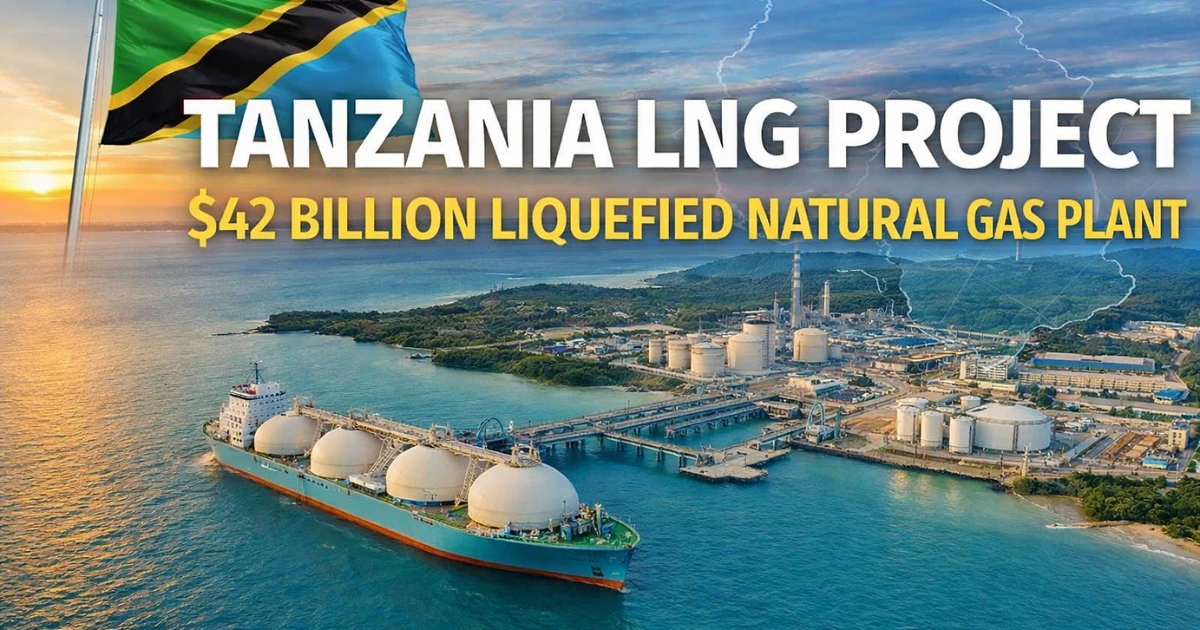
Tanzania Is Set to Build a $42 Billion Liquefied Natural Gas (LNG) Plant
Introduction
The Tanzania LNG project, valued at $42 billion, is moving closer to development and represents the largest energy investment in the country’s history. Once completed, the liquefied natural gas (LNG) plant is expected to position Tanzania as a major LNG exporter, strengthening East Africa’s role in the global natural gas supply chain.
Senior government officials have indicated that a long-awaited agreement to restart the stalled project is expected to be signed before June 2026, reviving momentum after years of delay.
Tanzania’s Vast Natural Gas Reserves
Tanzania holds more than 47 trillion cubic feet (TCF) of offshore natural gas resources, primarily located in the southern coastal and deepwater offshore areas near Lindi.
These reserves:
- Rank among the largest in Africa
- Provide a strong foundation for large-scale LNG production
- Enable exports to Asian, European, and African markets
The LNG project aims to monetise these reserves by liquefying natural gas for long-distance transportation. According to a Reuters report, the agreement governing the restart of Tanzania’s LNG project is expected to be signed before June 2026, subject to final legal approvals.
Overview of the $42 Billion LNG Project
The proposed LNG facility is designed to become the largest LNG processing plant in East Africa. The onshore development will process gas from offshore deepwater fields and is expected to include:
- Multiple LNG liquefaction trains
- Cryogenic LNG storage tanks
- LNG export jetties and marine infrastructure
- Utilities, safety, and environmental control systems
Due to its scale, the project is a cornerstone of Tanzania’s long-term energy and industrial strategy.
Project Partners and Operators
The LNG project is being developed by a consortium of leading global energy companies.
Joint operators:
- Equinor
- Shell
Other partners:
- ExxonMobil
- Pavilion Energy
- Medco Energi
- TPDC
The consortium plans to unlock Tanzania’s offshore gas potential through phased LNG development.
Project Status and Timeline
The project stalled after 2023 following proposed changes to a previously agreed financial framework. Although commercial terms were largely negotiated, the project did not reach Final Investment Decision (FID).
According to Tanzania’s Minister of State for Planning and Investments, Tanzania LNG projects:
- Commercial discussions are complete
- Negotiations are focused on finalizing the legal and fiscal framework
- The Host Government Agreement (HGA) remains the key pending item
Expected timeline:
- Agreement signing: Before June 2026
- FID: After legal and financing closure
- LNG production start: Approximately 8 years after project restart
Strategic Importance of the LNG Plant
The LNG project will play a critical role in:
- Export diversification – supplying LNG to Asia, Europe, and Africa
- Energy security – supporting global supply diversification
- Economic growth – boosting foreign exchange earnings and infrastructure
As demand for cleaner-burning fuels rises, LNG is increasingly viewed as a transition fuel supporting decarbonisation while maintaining a reliable energy supply.
Economic and Employment Impact
Authorities estimate the project could generate over 100,000 direct and indirect jobs.
Key benefits include:
- Large-scale employment during construction and operation
- Development of local LNG O&M skills
- Expansion of ports, logistics, and industrial infrastructure
- Increased government revenue through exports and taxation
For Tanzania, the project represents a long-term economic catalyst, not just an energy investment.
Tanzania’s Role in East Africa’s LNG Future
Alongside projects in Mozambique, Tanzania’s LNG development could help establish East Africa as an emerging LNG export hub, particularly for Asian markets. Europe’s push to diversify gas supply after the Ukraine conflict has further increased interest in East African LNG.
Challenges and Considerations
Despite its promise, the project faces several challenges:
- Extremely high capital requirements
- Environmental and regulatory approvals
- LNG price volatility
- Long construction and payback periods
Experiences from delayed LNG projects elsewhere in the region highlight the need for careful execution.If approved, the Tanzania LNG project could redefine Tanzania’s economic and energy future.
Conclusion
Tanzania’s proposed $42 billion LNG project marks a historic milestone for the country and the wider East African energy sector. With vast offshore gas reserves, a strategic coastal location, and renewed investor engagement, Tanzania is well positioned to become a major LNG exporter in the coming decades.
If the Tanzania LNG project reaches Final Investment Decision (FID) and is executed successfully, it could redefine the country’s economic trajectory and strengthen Africa’s role in global energy markets.
One thought on “Tanzania Is Set to Build a $42 Billion Liquefied Natural Gas (LNG) Plant”