HPCL and Oil India Team Up to Drive India’s Compressed Bio-Gas Revolution
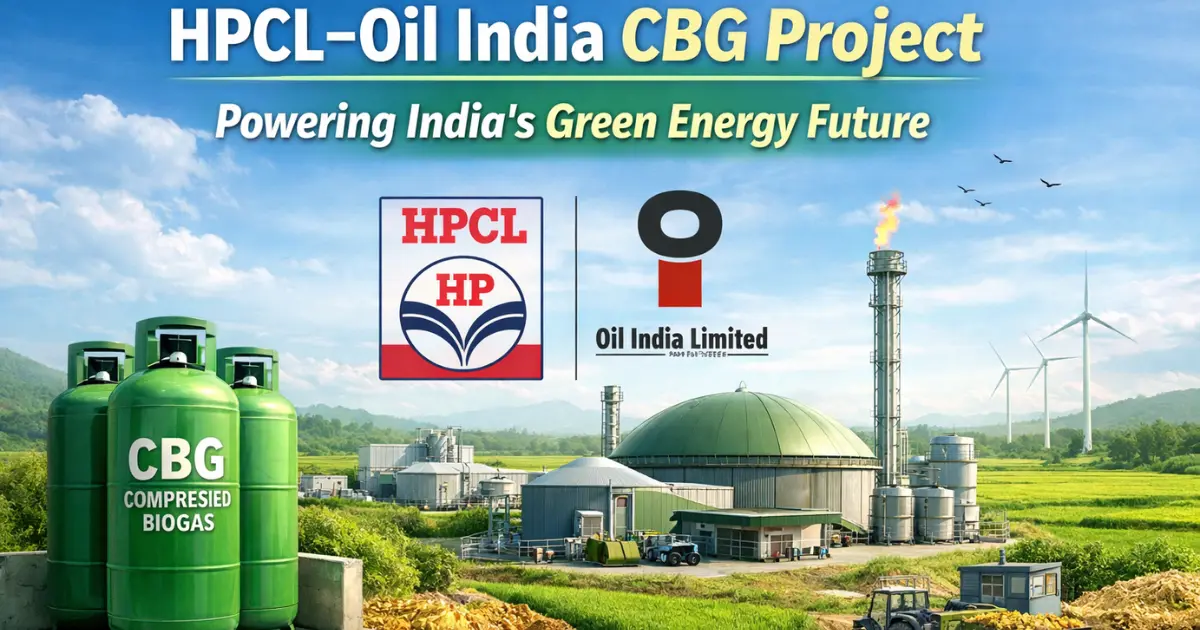
The HPCL Oil India Compressed Bio-Gas project marks a major boost to India’s clean energy transition, as Hindustan Petroleum Corporation Limited (HPCL) and Oil India Limited (OIL) join hands to develop sustainable and renewable biogas infrastructure across the country. In a major boost to India’s clean energy transition, Hindustan Petroleum Corporation Limited (HPCL) and Oil India Limited (OIL) have joined hands to develop a Compressed Bio-Gas (CBG) project, strengthening the country’s push toward sustainable fuels and energy self-reliance.
The collaboration brings together two leading public sector energy companies to promote renewable gas, reduce carbon emissions, and support the government’s vision of a greener energy ecosystem.
To know the difference between CNG, LNG, and PNG, including their uses and cost comparison, read our detailed guide here.
About the HPCL–Oil India Partnership
Under this strategic partnership, HPCL and Oil India will jointly explore, develop, and operate compressed biogas plants across select locations in India. The project will focus on converting organic waste and biomass—such as agricultural residue, cattle waste, and municipal organic waste—into CBG, a clean and environment-friendly fuel.
The initiative aligns with India’s SATAT (Sustainable Alternative Towards Affordable Transportation) scheme, which aims to promote biogas as an alternative to conventional fossil fuels like CNG and LPG.
What Is Compressed Biogas (CBG)?
Compressed biogas is a purified form of biogas that has properties similar to compressed natural gas (CNG). It can be used for:
- Transportation fuel
- Industrial and commercial energy needs
- Cooking gas applications
CBG helps reduce greenhouse gas emissions, improves waste management, and offers farmers and local communities an additional income stream.
Recently, ADNOC signed a $3 billion long-term LNG supply contract with Hindustan Petroleum Corporation Limited, highlighting India’s growing focus on cleaner gas-based energy—read the full details here.
Key Objectives of the CBG Project
The HPCL–Oil India CBG initiative aims to:
- Promote clean and renewable energy sources
- Reduce dependence on imported fossil fuels
- Support rural economy and waste-to-wealth initiatives
- Lower carbon footprint in the energy and transport sectors
- Strengthen India’s bio-energy infrastructure
Role of HPCL and Oil India
- HPCL will leverage its extensive fuel retail network and expertise in downstream operations to facilitate CBG distribution and market integration.
- Oil India Limited will contribute its experience in energy project development, gas handling, and infrastructure execution.
The synergy between upstream and downstream expertise is expected to ensure efficient project implementation and long-term sustainability.
Boost to India’s Green Energy Goals
The project supports national missions such as:
- Atmanirbhar Bharat
- Net Zero emissions target by 2070
- Swachh Bharat Mission through improved waste management
By encouraging the use of biogas, the initiative also helps reduce crop residue burning and methane emissions from untreated organic waste.
Economic and Environmental Impact
The CBG project is expected to:
- Generate local employment opportunities
- Provide additional income to farmers and waste aggregators
- Improve air quality by replacing conventional fossil fuels
- Promote circular economy practices
Such projects play a crucial role in balancing energy security with environmental responsibility.
Conclusion
The collaboration between HPCL and Oil India to develop a compressed biogas project marks a significant step toward India’s clean energy future. By combining expertise, infrastructure, and innovation, the two PSUs are helping build a sustainable fuel ecosystem that supports economic growth, environmental protection, and national energy security.
As India accelerates its transition toward greener fuels, initiatives like this CBG project will be instrumental in shaping a cleaner and more resilient energy landscape.
To know more about the LNG weight conversion and how many kilograms are obtained from 1 litre of LNG, click here.
2 thoughts on “HPCL and Oil India Team Up to Drive India’s Compressed Bio-Gas Revolution”