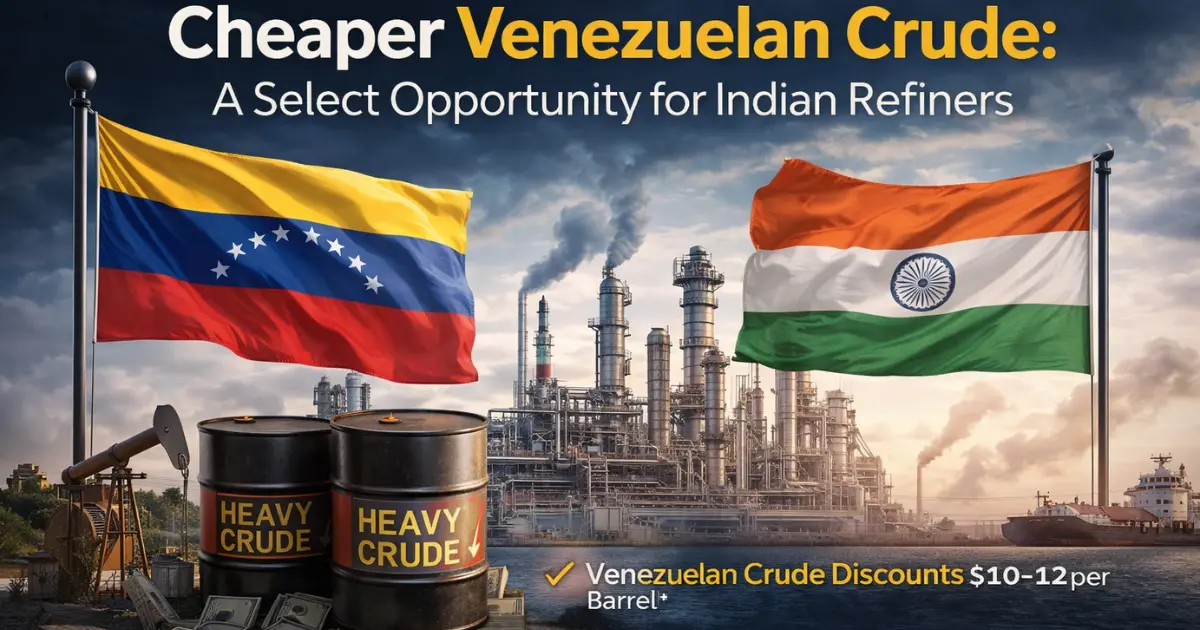
Cheaper Venezuelan Crude: A Select Opportunity for Indian Refiners
The Venezuelan crude discount is gaining attention in India’s refining sector as oil companies like BPCL evaluate importing discounted heavy Venezuelan crude to improve margins amid volatile global oil prices.India’s refining sector may be on the cusp of a quiet but important shift. Bharat Petroleum Corporation Limited (BPCL) is reportedly exploring the possibility of purchasing discounted Venezuelan crude, with market discussions suggesting a $10–12 per barrel discount to make the economics work.
If executed, this would mark BPCL’s first experience processing Venezuelan crude—a notable development given the nature of these grades. Venezuelan crude is predominantly heavy to extra-heavy, often high in sulphur and acidity, and cannot be run by most refineries without advanced upgrading units.
Table of Contents
ToggleWhy This Matters Now…?
Recent refinery upgrades across India have expanded the country’s ability to process more complex crudes. BPCL’s Kochi Refinery and Bina Refinery are now technically capable of handling heavier and more challenging feedstocks. In addition, BPCL’s upcoming refinery project in Andhra Pradesh is also expected to support such grades.
This reflects a broader strategy among Indian refiners: improving crude flexibility to stay competitive amid volatile global oil markets and shifting trade flows.
For a simple explanation of LNG invoicing in a regasification plant, click here to know more.
Benefits Likely Limited to a Few Refiners
Despite the headline appeal of cheaper crude, the benefits of Venezuelan oil are likely to be unevenly distributed across India’s refining landscape.
According to Kpler, Venezuelan crude can be processed by only a small number of Indian refineries, primarily those designed for heavy, high-sulphur crudes.
Private Refiners Best Positioned
- Reliance Industries – Its Jamnagar Refinery complex is among the world’s most complex refineries and historically the largest buyer of Venezuelan crude.
- Nayara Energy – The Vadinar Refinery was also a major importer in the past, though current sanctions-related constraints may limit its ability to resume purchases.
Public-Sector Refiners: Limited Scope
Among state-owned refiners, Venezuelan crude has only been processed in limited and intermittent volumes in the past—mainly at:
- Indian Oil Corporation (Paradip refinery),
- Mangalore Refinery and Petrochemicals Limited (MRPL), and
- HPCL-Mittal Energy Limited (HMEL).
Most public-sector refineries lack the configuration and operational flexibility to run Venezuelan heavy and extra-heavy grades at scale.
Venezuelan heavy and extra-heavy grades are not universally suitable across Indian refineries. While limited volumes have been processed at Paradip, MRPL, and HMEL, not all public-sector refineries can handle these high-TAN, extra-heavy crudes efficiently at scale.
— Sumit Ritolia, Lead Research Analyst (Refining & Modeling), KplerHowever, the availability of Venezuelan crude remains uncertain, as Venezuela’s oil production recovery continues to stall due to sanctions, infrastructure decay, and funding constraints, limiting the scale and consistency of discounted exports.
A Look Back: Venezuela–India Crude Trade
India was once a significant buyer of Venezuelan crude:
- Imports rose from ~400 kbpd in 2013 to nearly 500 kbpd by 2016.
- Volumes peaked around 540 kbpd in 2018.
- Imports fell sharply thereafter and dropped to zero by 2021 following U.S. sanctions.
During this period, Reliance’s Jamnagar refinery dominated purchases, followed by Vadinar, with MRPL importing smaller volumes.
Venezuela’s Oil Paradox
Despite holding the world’s largest proven oil reserves—about 303 billion barrels—Venezuela’s production remains subdued at roughly 1 million barrels per day, or ~0.8% of global output. Any recovery in supply is expected to be slow and uneven, shaped by sanctions, operational challenges, and investment constraints.
Sumit Ritolia notes that any improvement in Venezuelan exports will likely be gradual, limiting near-term impacts on global or Indian crude balances.
Investment Exposure and Sanctions Risk
According to ICRA, the Venezuelan crude discount remains attractive primarily because it is heavy and sour, making it structurally cheaper. However, risks remain high. Indian companies have invested in Venezuelan oil and gas blocks, but dividend payments are stalled and development has not progressed due to sanctions.
— Prashant Vasisht, Senior VP & Co-Group Head, Corporate Ratings, ICRA
Conclusion
A return of discounted Venezuelan crude to India’s import basket could offer cost advantages, but only to a select group of refiners with the right complexity and geopolitical flexibility.
For players like BPCL, even small volumes would signal a strategic shift—one that underscores how refinery upgrades and crude flexibility are becoming critical competitive tools in a challenging global oil market.