BPCL Bets Big on Petrochemicals While ONGC & IOC Hit the Brakes: A Strategic Split in India’s Energy Sector
India’s state-run energy giants are no longer moving in lockstep.
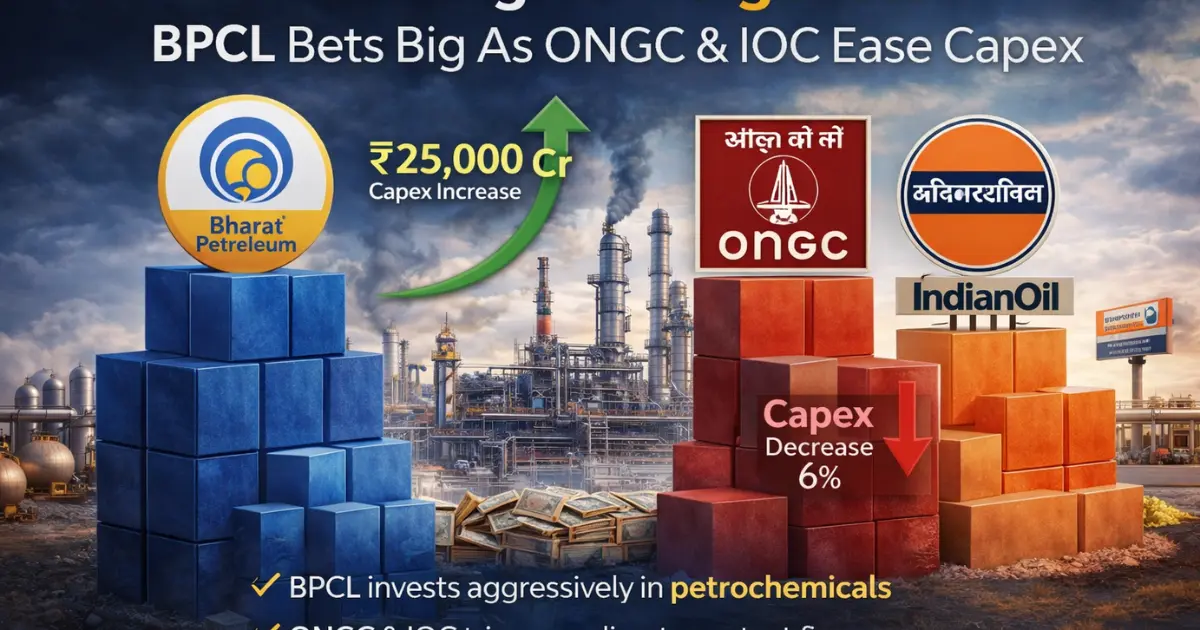
In FY26, Bharat Petroleum Corporation Limited (BPCL) has announced a bold 35% jump in capital expenditure to ₹25,000 crore, signalling a decisive push toward petrochemicals and downstream diversification.
Meanwhile, peers Oil and Natural Gas Corporation (ONGC) and Indian Oil Corporation (IOC) are taking a more cautious route—each trimming their FY26 capex by around 6%.
This divergence highlights a deeper strategic debate inside India’s public-sector energy ecosystem: invest aggressively for future margins—or protect balance sheets amid uncertainty?
🚀 BPCL’s Aggressive Petrochemical Push
BPCL’s FY26 capex plan of ₹25,000 crore marks a clear pivot away from pure fuel refining toward higher-value petrochemical products.
Key highlights:
35% Capex Increase: A sharp rise compared to last year, making BPCL the most aggressive spender among India’s oil PSUs.
Downstream Focus: Most of this investment is directed at petrochemical integration rather than traditional refining.
Refinery Upgrades: Mumbai and Kochi refineries are being enhanced with integrated petrochemical units, improving complexity and product diversity.
Strategic Rationale: Petrochemicals provide stronger margins and offer insulation from slowing transport fuel demand as EV adoption and cleaner energy policies accelerate.
In simple terms, BPCL is positioning itself for a future where plastics, polymers, and speciality chemicals matter as much as petrol and diesel.
Also See our detailed LNG terminals in India list to understand the infrastructure shaping the country’s gas market.
🛑 ONGC and IOC Choose Prudence
While BPCL accelerates, ONGC and IOC are applying the brakes.
ONGC (Upstream-heavy strategy)
- FY26 capex: ₹30,000 crore (≈6% lower than FY25)
- Continued focus on exploration and production
- Spending restraint reflects crude price volatility and pressure to maintain profitability
IOC (Balanced but cautious)
- FY26 capex: ₹32,700 crore (also ≈6% lower YoY)
- Prioritizing incremental refinery upgrades and selective petrochemical projects
- Scaling back broader expansion compared to BPCL’s bold downstream bet
Their approach suggests risk management over rapid diversification.
🔍 What This Means for India’s Energy Landscape
This split reveals three important trends:
1. BPCL Is Betting on Value Addition
By deepening petrochemical integration, BPCL aims to secure higher margins and reduce dependence on transport fuels.
2. IOC & ONGC Are Playing Defense
Their reduced spending reflects a desire to preserve capital while navigating energy transition pressures.
Confused about LNG billing? Learn the units used in oil and gas LNG billing with easy explanations and examples.
3. Integration Is Becoming the New Benchmark
India’s oil majors are increasingly judged by how well they blend refining, petrochemicals, and green energy—especially as Net Zero timelines (2040–2046) come into focus.
⚠️ Risks and Trade-offs
Every strategy carries its own challenges:
For BPCL
- Heavy upfront investment could strain finances
- Vulnerable to global petrochemical oversupply or demand slowdowns
For IOC & ONGC
- Conservative spending protects balance sheets
- But risks falling behind in downstream diversification and future-ready assets
Macro factors at play
- Global oil price volatility
- India’s renewable energy push
- Geopolitical supply-chain disruptions
All will heavily influence how these bets play out.
🧭 Final Take
BPCL is clearly choosing growth and transformation, while ONGC and IOC are prioritising stability and financial discipline.
Whether BPCL’s petrochemical-heavy strategy delivers superior long-term returns—or whether caution proves wiser—will depend on how quickly India’s energy mix evolves and how global markets behave.
One thing is certain: India’s public-sector oil majors are no longer following a single roadmap—and that strategic divergence will shape the sector for the next decade.
Confused between gas types? Learn the full comparison of CNG vs LNG vs PNG in our detailed article.
One thought on “BPCL Bets Big on Petrochemicals While ONGC & IOC Hit the Brakes: A Strategic Split in India’s Energy Sector”