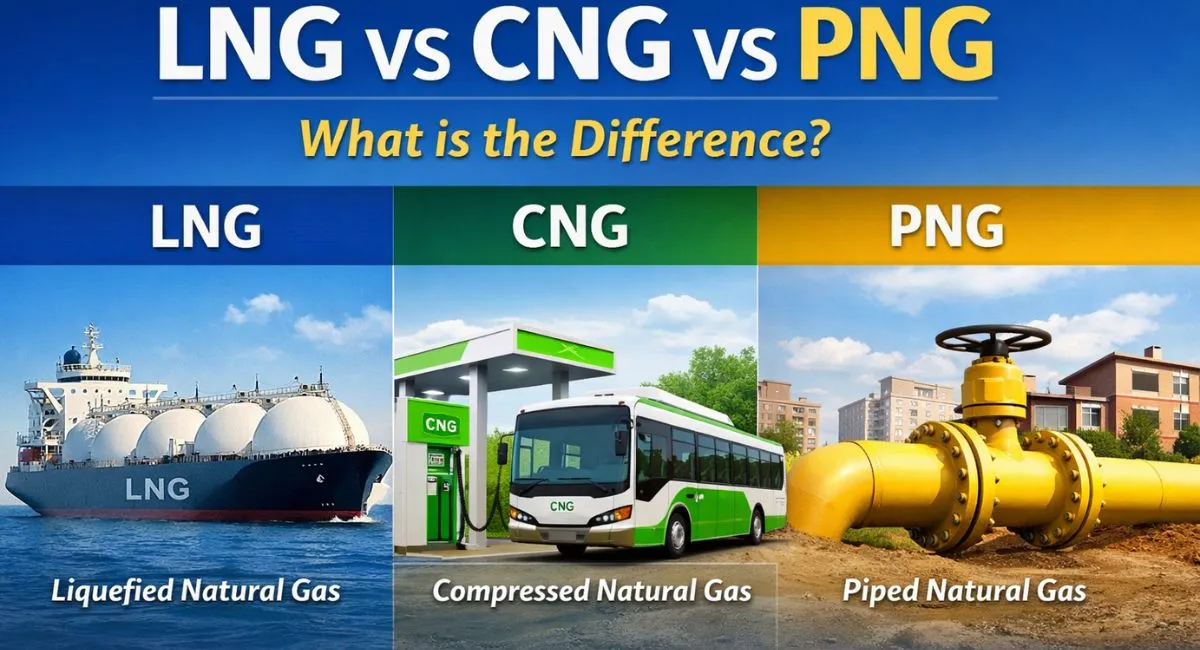
LNG vs CNG vs PNG What is the diffrence?
LNG vs CNG vs PNG is a common question when understanding how natural gas is stored, transported, and used in vehicles, industries, and households.
LNG, CNG, and PNG are all the same natural gas — the only difference is how the gas is stored, transported, and used.
Many people think these are different fuels, but in reality, they all come from a single source: natural gas. The names change only because the gas is handled in different forms to suit homes, vehicles, and industries.
Let’s clearly understand what LNG, CNG, and PNG are, how they differ, and where each one is used.
What is LNG (Liquefied Natural Gas)?
LNG stands for Liquefied Natural Gas. It is natural gas cooled to around –162°C, turning it into liquid form. This process reduces its volume by about 600 times, making it easy to store and transport over long distances.
Key Points of LNG
- Stored in cryogenic tanks
- Transported by LNG tankers and ships
- Requires special low-temperature handling
- High energy content
Uses of LNG
- Large industries
- Power plants
- LNG & LCNG stations
- Heavy-duty vehicles and long-distance transport
What is CNG (Compressed Natural Gas)?
CNG means Compressed Natural Gas, i.e., the same natural gas is compressed to very high pressure (around 200–250 bar) but remains in gaseous form.
Key Points of CNG
- Stored in high-pressure cylinders called cascades.
- No cooling required
- Cleaner than petrol and diesel
- Lower emissions
Uses of CNG
- Cars, autos, buses
- City gate stations
- Commercial vehicles
What is PNG (Piped Natural Gas)?
PNG stands for Piped Natural Gas. It is supplied directly through underground pipelines to consumers, without using cylinders. The gas is transmitted at medium pressure, typically in the range of 4 bar to 25 bar, and then regulated to much lower pressure before reaching homes and commercial users.
When natural gas is compressed to 200–250 bar, it is called CNG (Compressed Natural Gas).
PNG operates at medium pressure, not high pressure, making it safer and suitable for continuous pipeline supply.
Key Points of PNG
- Continuous gas supply
- No storage cylinders needed
- Supplied at low pressure
- Safe and convenient
To understand how LNG is safely transferred from cryogenic trucks to storage tanks without temperature or pressure loss, read our LNG Truck Unloading Process Explained (Step-by-Step).
Uses of PNG
- Household cooking
- Restaurants and hotels
- Hospitals
- Small and medium industries
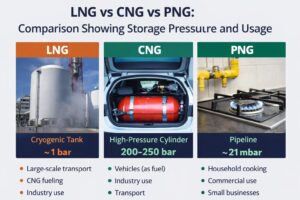
LNG vs CNG vs PNG: Comparison Table
| Feature | LNG | CNG | PNG |
|---|---|---|---|
| Gas Source | Natural Gas | Natural Gas | Natural Gas |
| Form | Liquid | Gas | Gas |
| Storage | Cryogenic tanks | High-pressure cylinders | Pipelines |
| Pressure | Low | Very high (200–250 bar) | Low-medium |
| Temperature | –162°C | Normal | Normal |
| Main Users | Industries, power plants | Vehicles | Homes & industries |
| Cost | Best for bulk use | Moderate | Most economical |
| Safety | Needs cryogenic safety | Needs pressure safety | Safest |
Which One Should Be Used?
Each form is designed for a specific purpose:
- LNG → Best for industries and long-distance transport
- CNG → Ideal fuel for vehicles
- PNG → Best for homes and commercial kitchens
Gas volumes and energy values are expressed using different units such as SCM, MMBtu, and barrels, which are explained clearly in our article on Units Used in Oil & Gas (SCM, MMBtu, Barrel).
There is no single best option among LNG, CNG, and PNG. Each form of natural gas is designed for a specific purpose. LNG is suitable for long-distance transport and large-scale storage, CNG is ideal for vehicles and industries, while PNG is best for household and commercial use through pipelines. This LNG vs CNG vs PNG comparison helps users clearly understand how different forms of natural gas are stored and supplied.
All three are the same eco-friendly fuels that help reduce pollution and dependence on traditional fossil fuels. In India, the storage, transportation, and distribution of natural gas are regulated by the Petroleum and Natural Gas Regulatory Board (PNGRB) to ensure safety and compliance with national standards.
Environmental and Economic Benefits of LNG, CNG, and PNG
LNG, CNG, and PNG play a major role in reducing air pollution and promoting cleaner energy usage. Compared to coal, petrol, and diesel, natural gas produces significantly lower carbon emissions and almost no particulate matter. This makes it an environmentally friendly fuel for both urban and industrial use.
From an economic point of view, natural gas helps reduce fuel costs for households, transport operators, and industries. PNG is especially economical for daily cooking needs, while CNG offers lower running costs for vehicles. LNG enables bulk transportation of gas to areas where pipelines are not available, supporting energy access and industrial growth. As countries move toward cleaner energy transitions, LNG, CNG, and PNG are considered bridge fuels that support sustainable development while reducing dependence on traditional fossil fuels
8 thoughts on “LNG vs CNG vs PNG What is the diffrence?”