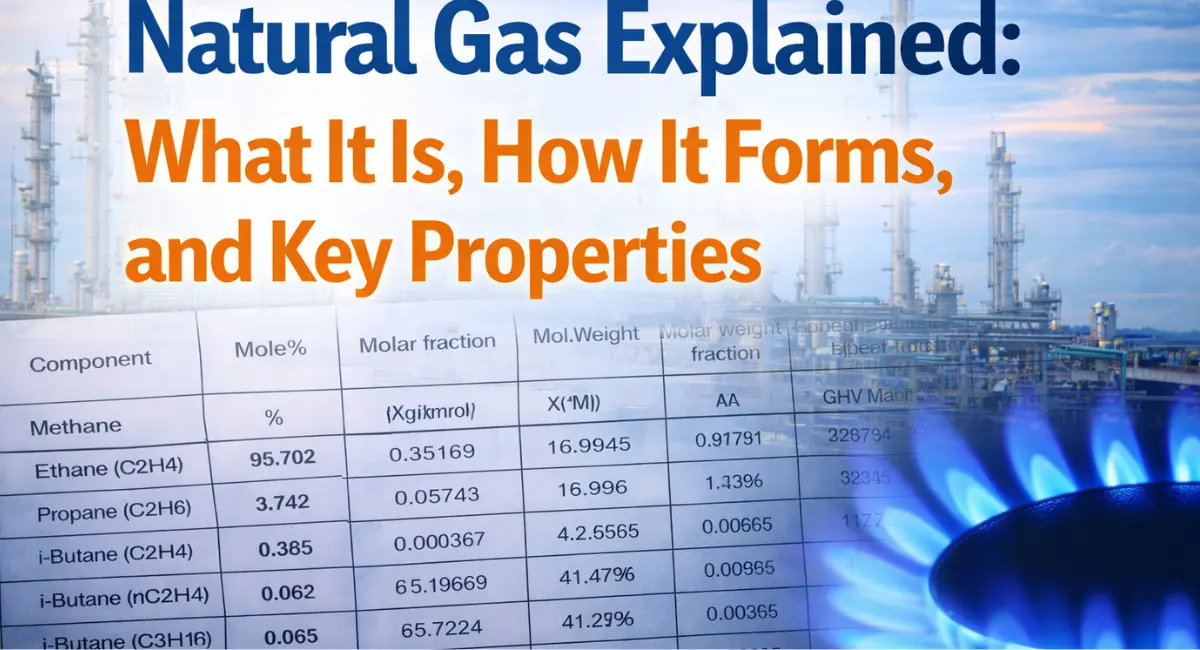
Natural Gas explained:what it is,How it is Forms,and key properties
What Is Natural Gas?
Natural gas is a naturally occurring hydrocarbon gas mixture primarily composed of methane (CH₄), along with smaller amounts of ethane, propane, carbon dioxide, nitrogen, and trace gases. It is one of the cleanest-burning fossil fuels and plays a major role in global energy systems, powering industries, households, and transportation. Lightweight, colourless, and naturally odourless, natural gas has become a cornerstone of the world’s transition toward cleaner and more efficient energy sources.
How Does Natural Gas Form?
Natural gas didn’t appear overnight. Its story began millions of years ago, long before humans existed.
Back then, Earth’s oceans were full of tiny plants and marine microorganisms. When these living organisms died, they slowly sank to the ocean floor. Over time, layers of mud, sand, and rock covered them, trapping the remains deep beneath the Earth’s surface.
As these layers built up over millions of years, the buried organic material was exposed to increasing heat and pressure. Deep underground, this extreme environment slowly changed the material into energy-rich substances called hydrocarbons.
The depth of burial played a key role. In shallower and cooler areas, oil was formed. But in deeper and hotter conditions, the organic matter transformed into natural gas, mainly methane. This long and gradual process is known as thermal maturation.
Today, when we use natural gas for cooking, electricity, or transportation, we are actually using ancient solar energy stored inside the Earth for millions of years. Natural gas is truly a gift from Earth’s deep past—released to power our modern world.
Where Do We Find Natural Gas?
Natural gas occurs in several types of geological formations:
1. Conventional Gas Reservoirs Found in porous rock formations, often alongside crude oil.
2. Unconventional gas sources: shale gas trapped within shale rock
Composition and Key Properties of Natural Gas?
– Methane (CH₄): 70–98%
– Ethane, propane, and butane: small amounts
– Inert gases: Nitrogen, carbon dioxide
-Trace elements: Hydrogen sulfide, helium
Important physical properties:
Yes, gaseous at normal temperature and pressure
– Colour: Colorless
– Smell: Naturally odorless (odor added for safety)
– Density: Lighter than air
– Flammability range: 5–15%
– Ignition temperature: Around 540°C
– Calorific Value: 8,000–9,500 kcal/Sm³
How Is Natural Gas Processed?
Before reaching consumers, natural gas must be purified; that is,
-Removal of water and oil
– Sweetening – removing H₂S and CO₂
– Dehydration – eliminating moisture
-Separation of natural gas liquids (NGLs)
-Liquefaction (if producing LNG) at −162°c
5 thoughts on “Natural Gas explained:what it is,How it is Forms,and key properties”