ONGC Commences Strategic Drilling in Andaman Offshore, Marking Milestone in National Energy Push
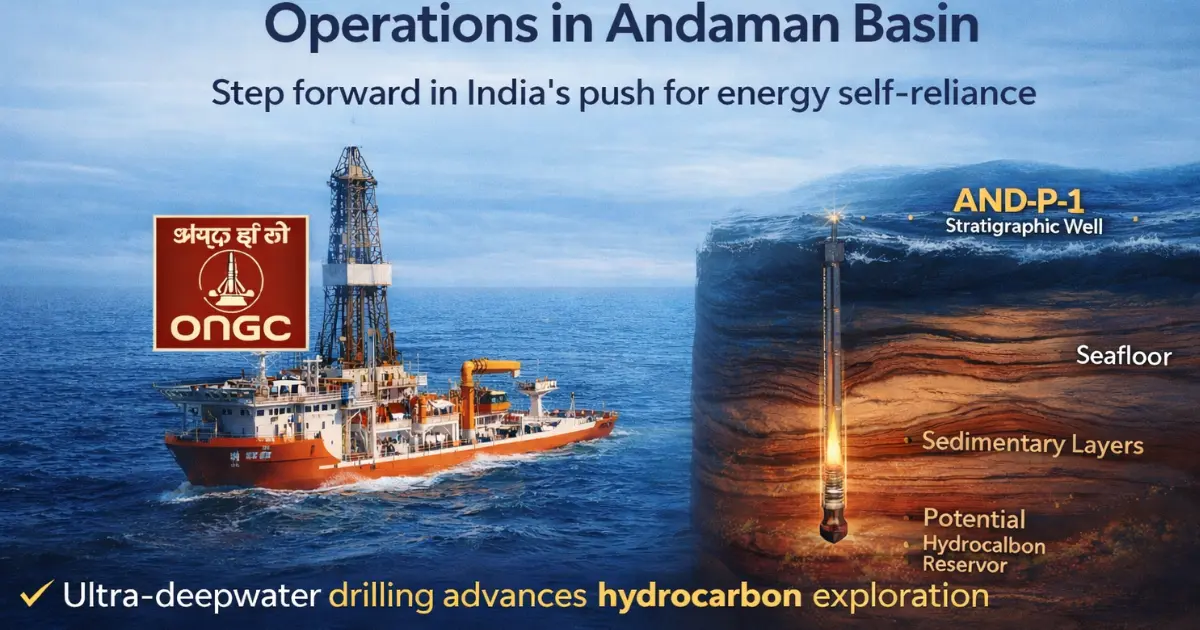
ONGC Andaman Basin drilling marks a major step in India’s domestic energy security push, as Oil and Natural Gas Corporation begins strategic deepwater exploration in the ultra-deepwater frontier. — In a significant stride for India’s domestic energy security, Oil and Natural Gas Corporation (ONGC) has commenced strategic drilling operations in the ultra-deepwater frontier of the Andaman Basin, underlining the nation’s intensified push to explore and harness domestic hydrocarbon resources.
On 27 January 2026, ONGC successfully spudded the AND-P-1 stratigraphic well, located roughly 267 nautical miles from the Andaman & Nicobar Islands on the Bay of Bengal. This operation is part of the Government of India’s broader #SamudraManthan campaign, aimed at enhancing indigenous energy production and significantly lowering dependency on hydrocarbon imports.
Strategic and Scientific Significance
Unlike conventional production wells, the AND-P-1 is a stratigraphic well — a type of scientific exploratory well drilled primarily for gathering essential subsurface data. Its key objective is to build a detailed geological understanding of deepwater rock formations, sedimentary layers, and potential hydrocarbon systems in one of India’s least explored offshore basins. This foundational data will be critical to de-risking future commercial exploration and informing subsequent exploration or development decisions.
The well’s successful spudding by ONGC involved complex logistics due to the remote location and extreme oceanic conditions, reflecting the technical capabilities being deployed in India’s deepwater frontier exploration efforts.
Looking for the LNG terminals operating in India? Explore our updated list covering major regasification facilities.
Context: India’s Deepwater Exploration Push
The Andaman offshore region has long been considered geologically promising but logistically challenging. Recent policy reforms and technological advances have encouraged energy companies to revisit frontier basins. Government initiatives—including opening up previously restricted offshore areas and supporting stratigraphic drilling campaigns—have aimed to expand the scope of hydrocarbon discovery beyond traditional producing regions.
In 2025, ONGC and Oil India Limited (OIL) announced plans for a ₹3,200 crore stratigraphic drilling campaign across several offshore basins, including Andaman, to broaden geological insight and potential reserve discoveries. International expertise, notably from energy major bp, has been integrated into these efforts through strategic partnerships to enhance drilling and subsurface analysis capabilities.
For deeper insight into India’s oil PSU strategy, read our analysis on BPCL’s petrochemical push versus ONGC and IOC’s cautious capex approach
Broader Energy Security Implications
India currently imports a large portion of its oil and gas demand, and reducing this dependency is a central objective of national energy policy. Strategic exploratory operations like AND-P-1 help identify new hydrocarbon prospects that could, over the long term, support domestic production and reduce the import bill.
The Andaman Basin’s geological setting, part of the larger Bengal-Arakan sedimentary system, has been validated as having potential hydrocarbon traps, backed by seismic surveys and earlier exploratory work by state-owned firms. These combined efforts—seismic data acquisition, stratigraphic drilling, and international collaboration — aim to unlock the basin’s energy promise and contribute to India’s vision of energy self-reliance.
Next Steps and Future Prospects
While the AND-P-1 drilling is currently focused on geological data acquisition rather than commercial production, the insights it yields will be foundational for future exploration strategy in the Andaman Basin. Should viable hydrocarbon systems be confirmed through subsequent analysis, India could see further exploration wells or discovery follow-ups in coming years.
As ONGC and partners push forward with these initiatives, the government continues to champion exploration in deepwater basins as part of its broader energy roadmap—balancing scientific inquiry with long-term economic and strategic energy goals.