The Strait of Hormuz: Why the World’s Most Critical Energy Chokepoint Matters During the Iran–Israel Conflict
The Strait of Hormuz energy chokepoint has become a major global concern as rising tensions in the Middle East following the latest Iran–Israel military escalation place energy markets on alert. Rising tensions in the Middle East following the latest Iran–Israel military escalation have once again placed global energy markets on alert. At the centre of this concern lies the Strait of Hormuz, a narrow maritime corridor that plays an unmatched role in global oil and liquefied natural gas (LNG) transportation.
For energy engineers, policymakers, and industry professionals, understanding the technical and logistical importance of this chokepoint is essential to evaluating how geopolitical conflicts influence fuel supply, pricing, and energy security worldwide.
What Is the Strait of Hormuz?
Engineering Importance of the Strait of Hormuz Energy Chokepoint
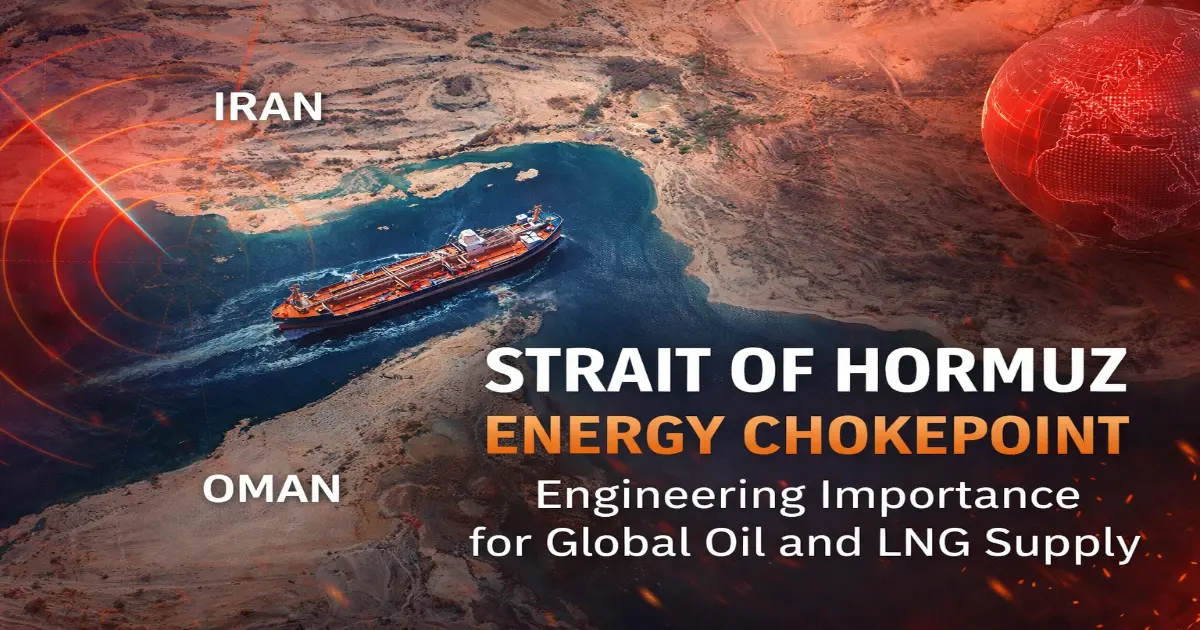
The Strait of Hormuz is a strategically located sea passage between Iran and Oman that connects the Persian Gulf to the Gulf of Oman and the Arabian Sea. Despite its relatively narrow width, it serves as the primary export route for oil-producing nations in the Middle East.
Energy chokepoints are narrow shipping routes through which a significant share of global fuel trade must pass. Any disruption—even temporary—can delay supply chains, increase freight costs, and trigger global price volatility.
Global Energy Flow Through the Strait
The scale of energy movement through Hormuz makes it the most important oil transit route in the world.
- Around 21 million barrels of oil per day moved through the strait in 2022.
- This represents roughly one-fifth of global petroleum consumption.
- More than 25% of global seaborne oil trade depends on this route.
- Nearly 20% of global LNG shipments also transit through the strait.
Most shipments are destined for Asian markets, with China, India, Japan, and South Korea being the largest importers.
From an engineering and logistics perspective, this concentration of energy flow creates a single-point vulnerability in the global fuel supply chain.
Why Chokepoints Create Engineering Risk
Unlike pipelines or diversified transport networks, maritime chokepoints cannot easily expand capacity during emergencies. When disruptions occur, several technical challenges arise:
- Shipping Congestion: Tankers must wait longer for safe passage, increasing demurrage costs and delivery delays.
- Insurance and Operational Risk: War-risk insurance premiums rise sharply, increasing transportation costs per barrel.
- Supply Chain Instability: Refineries operating under just-in-time crude supply models may face feedstock shortages.
- LNG Transport Sensitivity: LNG carriers require strict routing and safety clearances due to cryogenic cargo risks, making rerouting complex.
Read also: CGD Companies in India: Complete List and Market Overview
Can Oil Bypass the Strait of Hormuz?
Only limited alternatives exist.
- Saudi Arabia operates the East–West Pipeline, capable of transporting crude oil to Red Sea export terminals.
- The United Arab Emirates uses a pipeline connecting inland oil fields to the Fujairah terminal outside the Persian Gulf.
- Iran has developed the Goreh–Jask pipeline, though it remains underutilised.
Combined, these alternatives provide only partial backup capacity compared to the enormous volumes normally shipped through Hormuz. This means a major disruption would still significantly impact global supply.
Impact of the Iran–Israel Conflict on Energy Security
Recent military exchanges between Iran and Israel have raised fears of broader regional escalation. Any threat to shipping lanes increases the probability of:
- Temporary tanker suspensions
- Naval security operations affecting transit speed
- Higher oil and LNG prices
- Increased volatility in global fuel markets
Because energy infrastructure and maritime routes are closely tied to geopolitical stability, even perceived risks can influence market behaviour before physical disruptions occur.
Why India Is Especially Vulnerable
India imports a large portion of its crude oil and LNG from Middle Eastern producers whose exports pass through the Strait of Hormuz.
Potential consequences for India include:
- Rising petrol and diesel prices
- Increased LNG import costs for city gas distribution networks
- Pressure on inflation and industrial fuel expenses
- Higher fertilizer and power generation costs
From an engineering planning standpoint, this highlights the importance of diversification, strategic storage, and long-term energy security strategies.
Read also: LNG Regasification Process Explained
Engineering Lessons From Global Energy Chokepoints
- Energy systems require redundancy and alternate routing.
- Strategic petroleum reserves act as buffers against supply shocks.
- Pipeline diversification reduces maritime dependency.
- LNG infrastructure must incorporate operational flexibility during geopolitical risk.
Modern energy security is no longer only about production capacity—it is equally about transport resilience.
Future Outlook
While the Strait of Hormuz has remained operational through past conflicts, increasing geopolitical tensions continue to expose how fragile global energy logistics can be. As energy demand grows across Asia, reliance on this single maritime corridor will remain a critical concern.
For engineers and energy planners, the evolving situation serves as a reminder that fuel systems operate within both technical and geopolitical environments.
Conclusion
The Strait of Hormuz is far more than a geographic passage; it is the backbone of global oil and LNG transportation. Ongoing Middle East tensions demonstrate how quickly geopolitical developments can influence engineering operations, supply chains, and energy economics worldwide.
Understanding these interconnections is essential for building resilient fuel infrastructure capable of withstanding future disruptions.