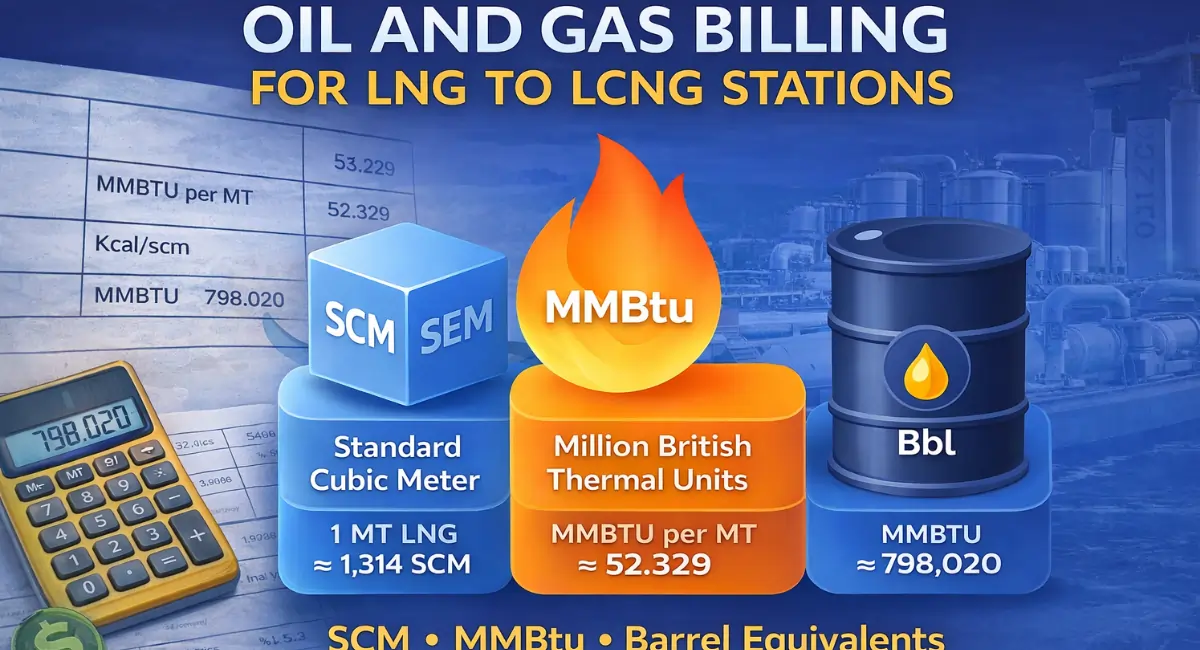
Units Used in Oil & Gas (SCM, MMBtu, Barrel) billing when supplying LNG to LCNG station
Units used in oil and gas billing for LNG to LCNG stations include SCM, MMBtu, and barrel equivalents. In the oil and gas industry, fuel is not billed only by weight or volume like other products.
In the industry, fuel is not billed only by weight or volume like other products. Instead, special energy and volume units are used to measure and bill natural gas, LNG, and related products.
When LNG is supplied to an LCNG station, understanding these billing units is very important for operators, engineers, and business owners.
In this article, we explain the most common units used in oil & gas billing—SCM, MMBtu, and barrel—in a simple and practical way.
Why Special Units Are Used in Oil & Gas Billing
Natural gas and LNG:
- Expand and shrink with temperature and pressure
- Are traded based on energy content, not just volume
- Are supplied in different physical forms (gas or liquid)
So billing is done using standardised units to ensure fairness and accuracy.
Units Used in Oil and Gas Billing for LNG to LCNG Stations
Typical natural gas conversion values used in LNG and LCNG billing
1. Units Used in Oil and Gas Billing
SCM (Standard Cubic Meter) is the volume of natural gas measured at standard conditions of pressure and temperature.
Standard conditions usually mean:
- Pressure: 1 atm
- Temperature: 15°C or 20°C (depends on country)
Where SCM Is Used
- Pipeline natural gas billing
- CNG sales
- LCNG station gas output
- Utility billing
Example
If an LCNG station supplies 10,000 SCM of CNG, it means:
- That volume of gas at standard conditions
- Independent of actual pressure during storage
2. MMBtu (Million British Thermal Units)
What Is MMBtu?
MMBtu is a unit of energy, not volume.
- 1 Btu = heat needed to raise 1 pound of water by 1°F
- 1 MMBtu = 1,000,000 Btu
This unit measures how much energy the gas contains
Why MMBtu Is Important in LNG Billing
LNG is mainly sold based on:
- Energy value
- Not just volume or weight
Because gas composition can vary, MMBtu gives a fair energy-based price.
Where MMBtu Is Used
- LNG supply contracts
- LCNG station LNG purchase
- International gas trading
- Power plant fuel billing
Example
If LNG is supplied at ₹900 per MMBtu, billing depends on:
- Total energy delivered
- Not tanker size alone
3. Barrel (bbl)
What Is a Barrel?
A barrel (bbl) is a volume unit mainly used for liquid hydrocarbons.
- 1 barrel = 159 liters
Is Barrel Used for LNG?
Not commonly used for LNG in LCNG stations..
Mostly used for:
- Crude oil
- Petroleum products
- Sometimes LNG equivalent in international statistics
Why It Still Matters
Barrels may appear in:
- Energy comparison reports
- LNG equivalent calculations
- Global oil & gas market data
4. How LNG Billing Works for LCNG Stations
In practical LCNG operations:
LNG Is Usually Billed In:
- MMBtu (energy-based billing)
- Sometimes kg or MT, but converted to MMBtu
CNG Sales Are Usually Billed In:
- SCM
- Or kg, depending on regulations
Simple LNG Conversion Reference (Approximate)
- 1 SCM natural gas ≈ 35.3 cubic feet
- 1 MMBtu ≈ 28–29 SCM (depends on gas quality)
- 1 ton LNG ≈ 52 MMBtu
Actual values vary with gas composition.
Why Energy-Based Billing Is Preferred
- Ensures fair pricing
- Accounts for gas quality
- Standard for international LNG trade
- Matches power generation and fuel efficiency needs
Accurate billing and measurement are closely linked to how LNG is processed before supply. To understand the technical side behind LNG conversion from liquid to gas, read our detailed guide on how LNG regasification works step by step.
Common Billing Mistakes to Avoid
- Confusing volume with energy
- Ignoring gas composition
- Using wrong standard conditions
- Mixing LNG liquid volume with gas volume
Proper understanding of units used in oil and gas billing is essential for accurate LNG to LCNG station billing and commercial transparency.Accurate billing depends on proper unit conversion across the LNG supply chain.
Conclusion
When supplying LNG to an LCNG station, billing is done using standard industry units like SCM, MMBtu, and sometimes barrel equivalents. Among these, MMBtu is the most important unit for LNG billing, while SCM is widely used for CNG sales.According to the BP Statistical Review of World Energy, energy-based units like MMBtu are widely used for LNG billing in global markets.
Understanding these units helps avoid billing disputes, improves transparency, and ensures smooth commercial operations in the LNG–LCNG value chain.
click to read more
6 thoughts on “Units Used in Oil & Gas (SCM, MMBtu, Barrel) billing when supplying LNG to LCNG station”