303 Billion Barrels Underwater: Why Venezuela’s Oil Giant is Stalling in 2026
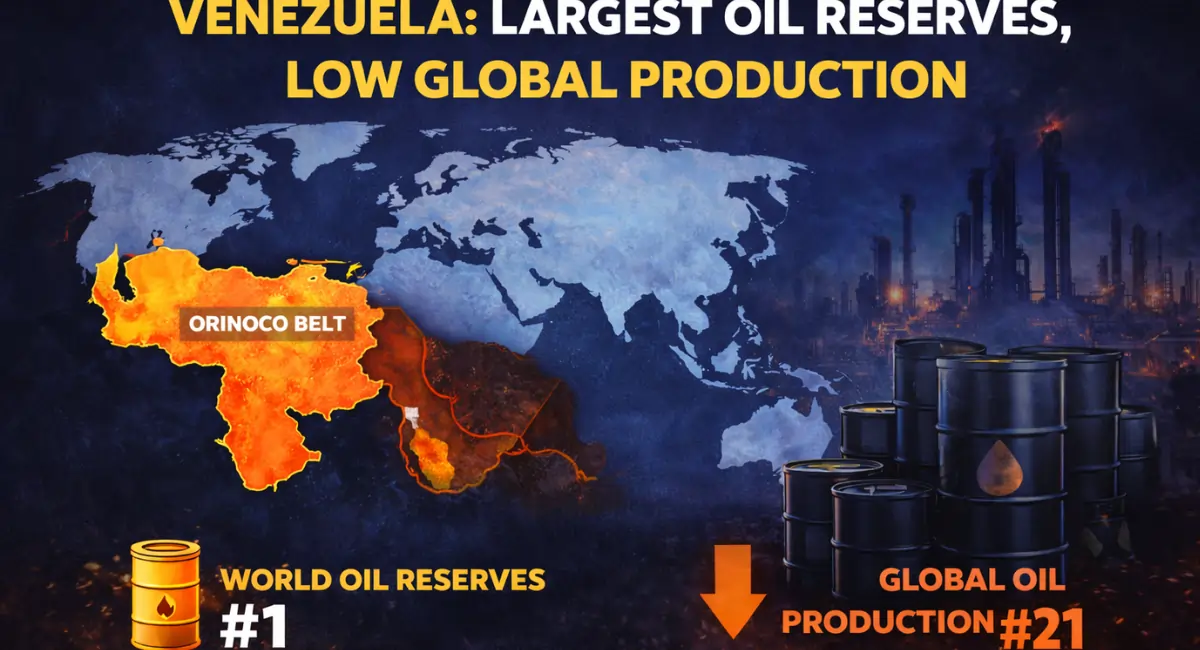
Venezuela’s oil reserves vs production is one of the biggest paradoxes in the global energy market.Venezuela, a founding member of OPEC, plays a critical role in global oil reserve statistics. Often described as a nation rich in “black gold”, Venezuela holds an estimated 303 billion barrels of proven oil reserves, representing about 17% of the world’s total. Often described as a nation rich in “black gold”, Venezuela holds an estimated 303 billion barrels of proven oil reserves, representing about 17% of the world’s total. This massive reserve base puts Venezuela ahead of oil heavyweights like Saudi Arabia and Iran, cementing its position at the top of the global reserves ranking.
However, despite this enormous resource base, Venezuela’s current oil production remains relatively low, revealing a significant gap between resource potential and real market influence.
Global Oil Reserves: Venezuela at the Top
According to data published by Visual Capitalist, Venezuela holds the world’s largest proven oil reserves, accounting for nearly 17% of the global total. Recent global energy data shows that just a handful of countries control more than half of the world’s proven oil reserves. Venezuela alone leads the list due to its massive reserve base concentrated mainly in the Orinoco Belt.
Orinoco Belt and Heavy Crude Oil
The Orinoco Belt contains mostly heavy and extra-heavy crude oil, which is far more complex to extract and process compared to conventional light crude.
Challenges include:
- High viscosity requiring thermal or advanced recovery methods
- Need for upgrading facilities and blending
- Higher operational and capital costs
These technical challenges reduce production efficiency without strong engineering support and continuous investment.
Heavy crude oil challenges
The real reason behind this gap lies in Venezuela’s Orinoco Belt. Unlike the light, free-flowing oil found in parts of the Middle East, most of Venezuela’s crude is extra-heavy.
A simple way to imagine it is this. Pumping light crude is like pouring water, while pumping Venezuela’s oil is like trying to move cold molasses.
Because the oil is so thick, getting it out of the ground isn’t easy. It needs to be heated just so it can flow. Once extracted, it must be chemically upgraded to make it usable. Even then, it often has to be mixed with lighter oil just to travel through pipelines.
So while the oil clearly exists underground, extracting and transporting it demands huge investments, advanced technology, and highly skilled engineering. Without these, much of Venezuela’s vast oil wealth remains locked beneath the surface.
Venezuela oil production decline
The gap between Venezuela’s potential and its reality is best seen in its production history. The fall from grace has been sharp:
| Metric | 1970s (Peak) | 2024 (Current) |
| Daily Production | ~3.5 Million Barrels | ~960,000 Barrels |
| Global Supply Share | Significant Player | ~1% |
| World Production Rank | Top 5 | ~21st |
While the United States has smaller reserves, it dominates global production through technology and infrastructure—proving that in the modern energy market, capability trumps quantity.
Extracting and commercialising oil or gas is only part of the energy value chain; accurate measurement and billing are equally critical. The same complexity exists in LNG supply chains, where volumes and energy content must be converted between multiple units. We have explained this in detail in our article on units used in oil and gas billing (SCM, MMBTU, barrel) during LNG supply to LCNG stations.
Why the Taps Are Running Dry
The decline isn’t just about the chemistry of the oil; it’s about the “plumbing” of the industry. Several factors have created a perfect storm:
- Infrastructure Decay: Decades-old equipment and lack of maintenance.
- The Brain Drain: Loss of skilled engineers and technical managers.
- Investment Vacuum: Geopolitical constraints and economic instability have chased away the foreign capital needed for multi-billion-dollar heavy-oil projects.
Energy Market Insight
Venezuela’s case clearly shows that large oil reserves alone do not guarantee energy dominance. This ongoing imbalance between Venezuela’s oil reserves vs production remains one of the most striking contradictions in the global energy sector. Sustainable production depends on:
Engineering capability
Maintenance and reliability
Investment and technology
Skilled operations and management
Conclusion
Venezuela’s story is a cautionary tale for the energy sector: reserves are just potential energy. Without a stable bridge of technology, skilled labour, and sustained investment, the world’s largest oil reserve remains a “stranded asset”.
While Venezuela remains the world leader in proven oil reserves, its production levels tell a different story. Without modernisation and sustained investment, its role in global energy markets will continue to remain limited. For Venezuela to reclaim its spot as a global energy superpower, the focus must shift from what is in the ground to the infrastructure on top of it.